
Nisha Agarwal
Research Scholar, IFHE University, Hyderabad
E Mail ID: nishaagarwal8276@gmail.com
Orchid id: 0009-0003-2185-4056
Prof. Dr. Venkateshwarlu. N
Dean (OU, SU, PU, MGU) & Hod at Osmania University, Hyderabad
E Mail ID: drvenkatlaw@gmail.com
Orchid id: 0009-0003-4484-4707
Abstract
The rapid integration of technology has completely changed the landscape of higher education delivery and access in India, particularly in legal education. The traditional model of face-to-face teaching has been replaced by a more flexible and technologically driven approach with the introduction of digital platforms, artificial intelligence (AI), and online learning management systems (LMS). While this has led to increased efficiency, accessibility and innovation, it has also raised critical governance and regulatory concerns. There is a regulatory lag as the current regulatory frameworks, such as the University Grants Commission and the Bar Council of India, operate on the assumption of the conventional modes of education.
This paper explores India’s evolving field of digital legal education, with a focus on the fit of the existing legal and policy regimes including the National Education Policy 2020. It assesses key challenges resulting from the deployment of artificial intelligence in education, such as quality, equity, privacy and integrity. The analysis is further enhanced with a comparative perspective and empirical data representing the experiences of students and teachers in a digital learning environment.
The research suggests that while the use of technology can enhance access to education, without a comprehensive regulatory approach, quality of education and equity may be compromised. It concludes that in order to ensure that the digital transformation in education is equitable and transparent, it is essential to have a balanced approach to learning and ensure that innovation is complemented with effective regulation.
Keywords: Digital Education, Legal Education, Artificial Intelligence, Regulatory Challenges, NEP 2020, Data Privacy
1. Introduction
The fast-paced development of technology in the field of education and learning has lead to a number of changes in the education sector of India. Technology has been utilized not only within the classroom environment but at times even in lieu of learning in the classroom environment. The outbreak of coronavirus has speeded up the process and thus, legal education in India has witnessed transformation into the form of virtual education. Digital education has many advantages, including those of access and convenience. However, along with these many problems arise in relation to quality control, privacy, cheating, and regulation. The existing system of regulation under the Bar Council of India and University Grants Commission has a very difficult task in dealing with these problems.
Moreover, there exists a disconnect between policies and its implementation, particularly with respect to the National Education Policy 2020. Questions of data protection, brought up in Justice K.S. Puttaswamy v. Union of India[1], also indicate the need for an effective regulatory framework.
The aim of this article is to critically discuss the relationship between technology and digital learning, with special emphasis on law in India. This article intends to evaluate the adequacy of existing legal frameworks with respect to ensuring that technology aligns with the standard of education.
- Conceptual Framework
It will be important to have insights on how technology, learning, and regulations interact in order to understand the development of education in relation to digitization. Digital education is nothing more than the application of digital instruments, technologies, and platforms in learning beyond the conventional setting.
Another important term associated with digital education includes Education Technology or EdTech. This involves the use of modern technological advancements in improving education delivery. Legal education through EdTech has resulted in developments like virtual mock courts, databases, and collaborative platforms among others.
Increasingly, artificial intelligence has become relevant in digital education. Artificial intelligence has made it easier to conduct research, drafting, and personalized education. Nonetheless, there have been concerns about integrity with increased AI applications.
When it comes to regulation, organizations such as the University Grants Commission and the Bar Council of India have the mandate of guaranteeing academic quality. However, their regulatory framework, which has been tailored to control a traditional educational system, seems to be having a hard time coping with the new times.
The framework described above offers an insight into how technology and regulation relate in the legal education setting.
3. Legal and Regulatory Framework in India
The increased use of online education in India has become an issue that necessitates reconsideration of the current regulatory situation related to higher and legal education. While technology has completely transformed the approach towards delivering education, the regulatory bodies continue to operate in a system where conventional education prevails; hence, there is an imbalance between development and regulation. The University Grants Commission is in charge of regulation of higher education in India, covering the development of e-learning policies and accreditation of online degree courses.[2] It promotes the use of technology through the introduction of initiatives such as SWAYAM and MOOCs. However, these initiatives seek to increase infrastructure while neglecting the aspect of quality assurance and monitoring.
As regards legal education, BCI acts as the regulatory body in relation to the curriculum development process, qualification of teachers, and institutional accreditation.[3] The regulatory body’s focus on conventional modes of study is a factor that makes adaptation to online instruction difficult due to lack of guidelines.
It has become clear from the National Education Policy, 2020, that digital transformation has been recognized, along with its focus on technology use and digital learning.[4] However, these policies still lack enforceability and seem to be very aspirational in nature.
Data protection and privacy laws have become very significant in the area of digital learning. More and more personal data of students is being collected and stored, thus making way for concerns related to consent and safety. The historic judgement in the case of Justice K.S. Puttaswamy v. Union of India emphasizes the importance of privacy as a fundamental right.[5] In this context, there is an urgent need for sectoral-specific governance rules for the protection of citizens.
To sum up, it can be concluded that there is still no uniformity in the regulations governing the issue of digital education in the Indian context. Although several steps have been taken in this direction by various authorities such as UGC, BCI, NEP, 2020, etc., there is definitely a significant gap.
4. Role of Technology in Legal Education
Technological advancements have transformed the traditional modes of teaching, learning, and legal training. The integration of technology has increased the accessibility, flexibility, and efficiency of legal education, thereby allowing legal education to transcend the traditional boundaries of the classroom. This can be best illustrated by the integration of online learning platforms, virtual classrooms, and digital learning tools, which have significantly impacted legal education in India.
Digital platforms have expanded access to legal education through online learning platforms, which offer Massive Open Online Courses (MOOCs) on varied subjects, including legal studies. The integration of SWAYAM has allowed students to access legal education, thereby providing access to inclusive education. This has allowed students to access legal education, thereby providing access to legal studies across geographical boundaries.
The integration of technology has significantly impacted legal research, thereby providing legal scholars with access to digital tools, thereby significantly impacting legal research. Artificial intelligence tools have significantly impacted legal research, thereby providing legal scholars with access to legal research tools, thereby significantly improving the academic and professional competence of law students.
Another important development is the practice of virtual moot courts and online simulations, where students can practice legal proceedings in a digital environment that closely resembles real-life legal proceedings. Similarly, learning management systems (LMS) also offer an opportunity to conduct online classes and assessments in an effective manner.
In addition, technology has also given the opportunity for co-learning and an interdisciplinary approach to teaching and learning, in which students can also participate in webinars and seminars across the world. This also enables learning about various legal systems and issues in the world.
However, it is also necessary to understand that while technology offers us an opportunity to make learning more seamless and effective, it is also important to undertake a balancing act for ensuring that the essence of legal education is not compromised. Therefore, technology is not a substitute to learning; rather it provides an opportunity to make it better
5. Regulatory Challenges in Digital Legal Education
The increased incorporation of technology in legal education has also brought to the fore some regulatory issues, which have led to doubts about the efficacy of the current governance system. While various governing bodies, such as the University Grants Commission (UGC) and the Bar Council of India (BCI), have taken several measures in order to incorporate technology in legal education, their guidelines are still ineffective in addressing the issues associated with the increased incorporation of technology in legal education.
The first issue that is associated with the incorporation of technology in legal education is the issue of quality control and standardisation. This is because the incorporation of technology, in contrast to other modes of teaching, has no standard method of teaching and assessing students.
Another significant concern is the digital divide which continues to restrict equitable access to education. This is because the students from rural and poor backgrounds may not have access to the internet and devices, or technological skills. This results in a gap in learning which is inconsistent with the focus on inclusion as mentioned in the National Education Policy 2020.
The issue of data privacy and surveillance is another major issue that creates a significant regulatory challenge in this context. This is because digital education platforms require access to vast amounts of personal data, including attendance, academic performance, and behavioral data. This issue assumes significance in light of the recognition of data privacy as a fundamental right in Justice K.S. Puttaswamy v. Union of India.
Moreover, the emergence of artificial intelligence in the field of education has also posed some challenges regarding academic integrity and ethical behavior. Though artificial intelligence is helpful in the field of education, it is also being misused in the context of academic integrity and ethical behavior. The absence of proper guidelines[6] regarding the proper utilization of artificial intelligence in the field of education has also weakened the hands of the authorities in this regard.
Furthermore, there is a vacuum in the legal guidelines regarding EdTech platforms. The operations of digital education platforms are not being monitored in an effective manner, and they are giving more priority to their business than to education.
Lastly, the inflexibility of existing legal education regulations, especially those set by the Bar Council of India, acts as a barrier to innovation. Traditional regulations with regard to attendance, teaching, and curriculum delivery are not aligned with digital learning, thereby limiting the full potential of technology in legal education.
To conclude, it is clear that there are multiple issues with regulating legal education. In essence, this is a problem of regulatory lag, where the pace of technological change has far surpassed regulatory change. This, in turn, demands a re-examination of regulatory frameworks for the regulation of digital legal education.
6. Comparative Analysis of Digital Legal Education: India, United States and United Kingdom
Regulations of digital education, particularly in fields like law, are very different in different countries. This can be juxtaposed against the regulation of other developed economies such as the United States and the United Kingdom. Such a comparison can prove to be very useful for understanding the shortcomings of India’s regulations and can provide a platform for improvement.
In the United States[7], the overall regulation of digital education is carried out by the government as well as independent accrediting bodies. The overall regulation of online legal education is carried out by accrediting bodies like the American Bar Association (ABA). The ABA provides guidelines for online legal education, including distance learning, faculty engagement, student assessment, and issues of integrity. The ABA allows a structured integration of online learning with law studies, thereby ensuring that technological innovation does not lead to a compromise in the quality of education.
Similarly, in the United Kingdom, there are institutions like the Quality Assurance Agency for Higher Education (QAA), which provides extensive benchmarks in traditional as well as digital forms of education. The UK system focuses on outcome-based education, continuous monitoring, and institutional accountability. In this system, digital learning is not seen as an exception but an integral part of education in general and higher education in particular, with defined quality assurance mechanisms in place.
India’s regulatory regime of digital learning in legal education, led mainly by the University Grants Commission (UGC) and the Bar Council of India (BCI) is in a state of flux. While policies such as the National Education Policy 2020 talk about online education in a broad sense, there is no clarity on the standards for online legal education. India does not have a standardised system of accreditation for online legal education like the US and UK systems.
The other key difference is the regulation of EdTech platforms. In the US and UK, online education platforms must adhere to rigorous rules with respect to transparent modes of delivery, qualifications of the faculty and data safety measures. But in India, EdTech platforms are not operated under any control or oversight, which is a big concern.
This comparative study shows that while India has made significant strides in adopting digital education, it is lacking in the development of an effective framework in this regard. International examples stress the need to establish accreditation norms, institutional regulations, and norms on the application of technology in legal studies.
7. Case Laws: Judicial Perspective on Digital Education and Rights
The dynamic nature of digital education in India also involves considerations of the right to education, right to privacy, and dignity under Article 21 of the Constitution. The judicial pronouncements of the Supreme Court of India have also been very important for the development of the legal framework that is applicable to digital education.
One of the most important judicial pronouncements that can be made here is the judgment of the Supreme Court of India in the case of Justice K.S. Puttaswamy v. Union of India, where it recognized the right to privacy as a part of Article 21 of the Constitution. The importance of this judgment can be understood from the perspective of the collection, storage, and use of a large amount of student information by online platforms of digital education.
Another case is that of Mohini Jain v. State of Karnataka,[8] where the Supreme Court has held that the right to education is an essential part of the right to life under Article 21 of the Constitution. This was further reinforced in the case of Unni Krishnan v. State of Andhra Pradesh,[9] where the court recognized the role of the State in providing access to education. In the digital age, these cases take on a fresh significance, as access to education is increasingly dependent upon access to digital technologies.
The Supreme Court has also dealt with the issue of access to digital technologies in the case of Anuradha Bhasin v. Union of India,[10] where it was held that freedom of speech and expression over the internet is constitutionally protected. Although the case related to the issue of the shutdown of the internet, it is relevant to the issue of digital education because access to the internet is essential for the effective conduct of online education.
Further, in Internet and Mobile Association of India v. Reserve Bank of India, the Court has highlighted the need for proportionality in regulating digital spaces. This has implications in terms of regulating online education while promoting innovation.
Overall, these judicial pronouncements underscore the fact that digital education is not merely a technological advancement; it is embedded in constitutional rights and freedoms. These decisions provide a basis for ensuring that technological advancements in the field of education are in consonance with principles of privacy, accessibility, equality, and fairness. These decisions also underscore the need for a robust regulatory framework to balance constitutional values and the challenges of the digital world.
8. Empirical Study: Analysing Student Perceptions on Digital Legal Education
Bar graph: 1 For “Internet Access” based on the data
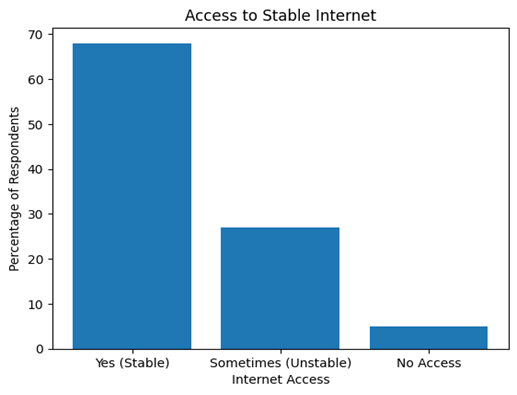
- Yes (Stable): ~68%
- Sometimes (Unstable): ~27%
- No Access: ~5%
It may be observed from the above findings that although the great majority of the interviewees have stable access to the internet, there is also a fairly large number of people who have only sporadic access to the internet, and there are a few people who lack access to the internet completely. In other words, there are stratified types of digital divides in this case as well. This implies that the concept of the digital divide cannot be merely limited to the issue of access nowadays, but has become highly qualitative because stability and reliability of internet access are extremely crucial factors when it comes to the success of the educational performance of the interviewees. The peculiarity of legal education requires that there should always be stable access to the internet.
Bar graph: 2 For Device Used based on the data
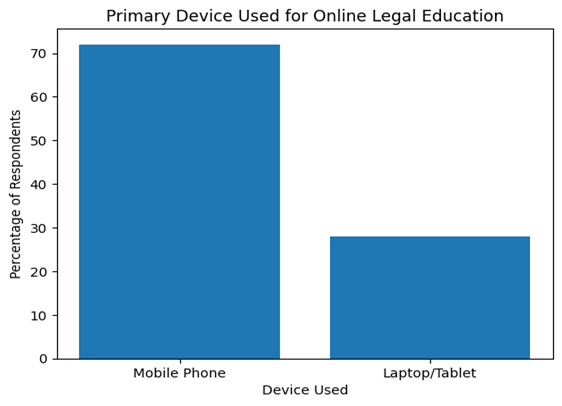
- Mobile Phone: ~72%
- Laptop/Tablet: ~28%
As follows from the data presented, the domination in using mobile phones for studying purposes (around 70-75%) is evident. In contrast, the proportion of students using laptops or tablets is relatively low (25-30%). This is an example of the fact that there are certain functional barriers in terms of access, as digital access is assured; however, educational access becomes severely limited. While mobile phones may be used to perform certain tasks (such as attending online classes), it is not possible to perform more complex legal tasks (such as searching through large databases [SCC Online, Manupatra] or practise drafting skills). This unevenness illustrates that there are some functional restrictions in terms of access, as we know that digital access is guaranteed; but, educational access is highly limited.
Bar graph: 3 For “Effectiveness of Digital Education” based on the data
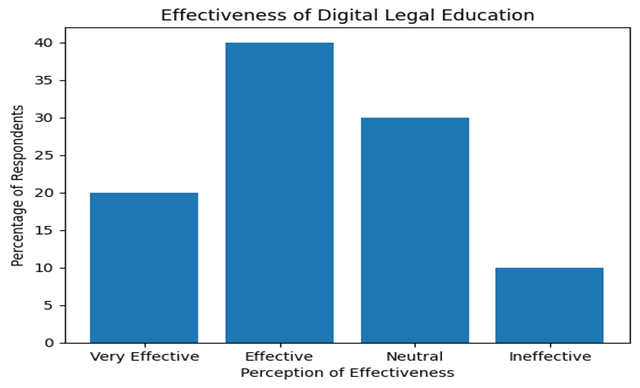
- Very Effective: ~20%
- Effective: ~40%
- Neutral: ~30%
- Ineffective: ~10%
The results show that a bulk of students demonstrate a moderate level of consent towards digital legal education, with 40% viewing it as effective, 30% as neutral, 20% as very effective and 10% as ineffective. It is possible to conclude that while the digital approach to education has gained some functional legitimacy in terms of theoretical teaching as well as its accessibility, it has not gained full normative and pedagogical legitimacy in legal education. The fact that there is a significant number of neutral responses shows that the educational process here is somewhat complex, with students appreciating the use of technology in education, but being sceptical about the transmission of doctrinal knowledge.
Bar graph: 4 For “Preferred Mode of Learning” based on the data
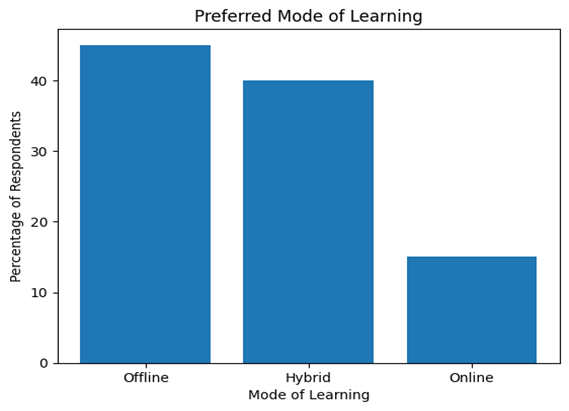
- Offline: ~45%
- Hybrid: ~40%
- Online: ~15%
These data evidently demonstrate the prevalence of the face-to-face (~45%) and blended (~40%) types of education over the online (~15%) type, showing a critical component of legal education as far as its theoretical foundations are concerned. This ratio reveals that the education in law demands the experiential, dialogical and practical nature of learning, which is based on personal interactions, simulation games and immediate collaboration, which is hardly possible in purely online environments.
The low popularity of online education also does not imply just the resistance to modern technology, but rather the understanding of its inability to adequately prepare lawyers in various fields of study, particularly those related to the development of litigation skills, writing and analysis. At the same time, the equal inclination towards hybridity implies a dramatic move from the traditional educational model to its supplementation using technical assistance.
Bar graph: 5 For “Practical Learning Impact” based on the data
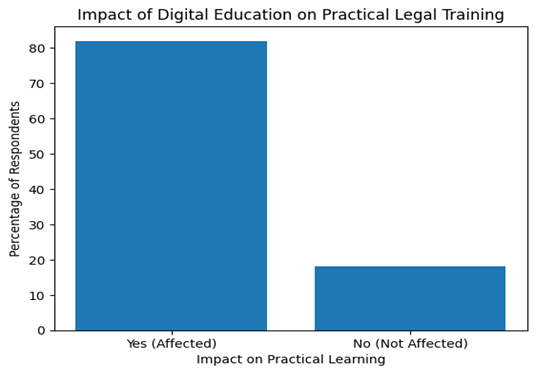
- Yes (Affected): ~80–85%
- No (Not Affected): ~15–20%
Based on the findings provided, one can state unequivocally that there is no denying the fact that an enormous majority of those surveyed (around 80-85%) consider the presence of a negative effect on the quality of legal education due to the absence of practical experience in the digital format, making up a critical shortcoming of digital legal education from the standpoint of an institution. Although certain subjects lack any practical aspect, it does not apply to legal studies, whose main objective is to implement theoretical knowledge in practice through engagement in moot courts, internships, client counseling, and mock trials – all of which are challenging to conduct in the digital format. At a deeper level, it follows from the results obtained that although digital legal education is very effective in terms of educating students, it still falls short of incorporating any practical elements of implementation, thus proving that such a format of legal education cannot stand alone but should be supplemented with offline experience.
Bar graph: 6 For “Use of AI Tools” based on the data
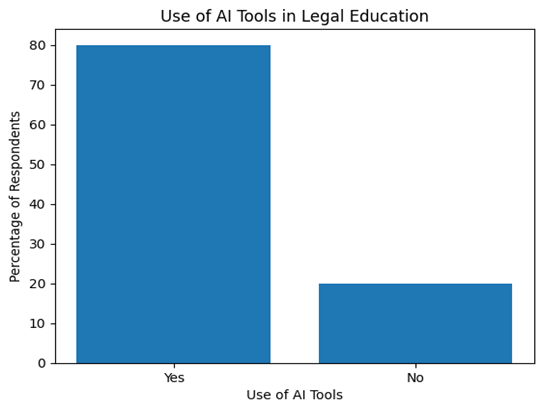
- Yes: ~80%
- No: ~20%
In this regard, it should be stressed that the majority of respondents have adopted AI (around 80%). Thus, the use of AI has become an important aspect of modern legal education, particularly, when students conduct research and write. While the use of technological solutions is beneficial for educational purposes, it is critical to pay attention to such normative and ethical issues that have been raised by the rapid development of technology and widespread adoption of AI solutions.[1] The thing is that the current doctrinal framework does not provide sufficient guidelines on the use of technologies, thus, contributing to those problems. It is interesting to highlight the behavior of another group of students who do not adopt AI technologies (approx. 20%). Apparently, this trend has led to splitting of the society into two categories – adaptive to technology and non-adaptive to technology.
Bar graph: 7 For “Regulation Awareness” based on the data
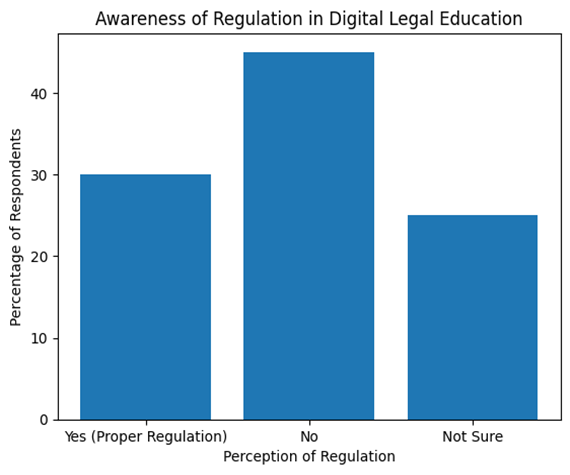
- Yes (Proper Regulation): ~30%
- No: ~45%
- Not Sure: ~25%
As seen from the findings, there was a prevalent opinion amongst the participants about the problem associated with the inadequacy of regulation of the provision of legal education using digital media. More than forty percent of the participants clearly mentioned this problem while almost twenty-five percent of the participants fell in the middle ground and did not have any concrete answer. Only thirty percent participants were of the view that there was proper regulation being practiced. It clearly indicates that there was some deficiency as far as regulatory framework was concerned amongst the participants and it also showed that despite the fact that there was an increase in the use of digital technology and AI tool for providing legal education, a corresponding increase in the regulatory measures was not noticed. As per doctrinal knowledge, this situation is quite parallel with the concept of “regulatory lag”. It is because of the failure of the law or policies to cope with technological developments that a gap is created and can be misused.
Bar graph: 8 For “Data Privacy Concern” based on the data
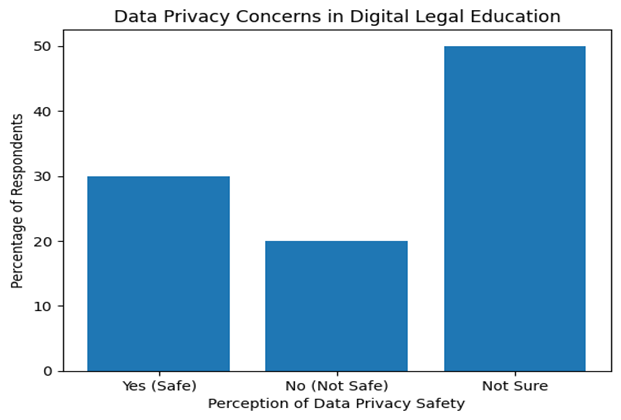
- Yes (Safe): ~30%
- No (Not Safe): ~20%
- Not Sure: ~50%
There seems to be high levels of uncertainty related to the privacy of personal data being compromised due to technological adoption in legal education with over 50% of the respondents not certain about the safety of personal datawhile almost 30% believe that the data will remain safe. On the contrary, almost 20% consider their data to be unsafe. This suggests that there is high levels of trust deficits and poor knowledge regarding the application of tools for digital governance. As far as constitutional laws go, this is highly problematic because the Supreme Court of India has held in Justice K.S. Puttaswamy v. Union of India (2017) that the right to privacy is a constitutional right protected by Article 21 of the Constitution. This means that there are high levels of risks involved pertaining to privacy of data[2] because of the lack of institutionalization and awareness. There is an urgent need for formulating a suitable policy mechanism.
Bar graph: 9 For “Fairness of Online Examinations” based on the data
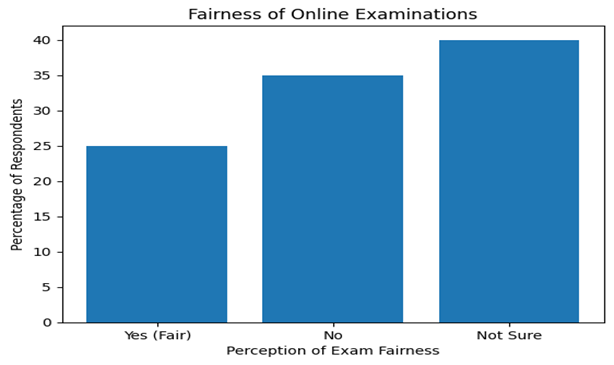
- Yes (Fair): ~25%
- No: ~35%
- Not Sure: ~40%
In regard to the level of suspicion or uncertainty, we may state that there exists a relatively high degree of both, as not many of the respondents (~25%) are sure of the fairness of the examinations conducted digitally. At the same time, an even higher percent of the respondents (~35%) suspect the integrity of the mentioned examinations, whereas there is nearly 40% of those who are just uncertain about this. These statistics show that there is a considerable problem of the credibility when assessing the digital exam system, namely its ability to avoid cheating, regulate the system and give a non-biased evaluation of the students’ performance. The issue of the legislative relevance of the research results is rather important, as it implies that it is necessary to develop a legal framework, allowing for the fair procedures during digital evaluation. In turn, the importance of such aspect is obvious in relation to the field of law studies.
Bar graph: 10 For Recommendation for Continuing Digital Education based on the data
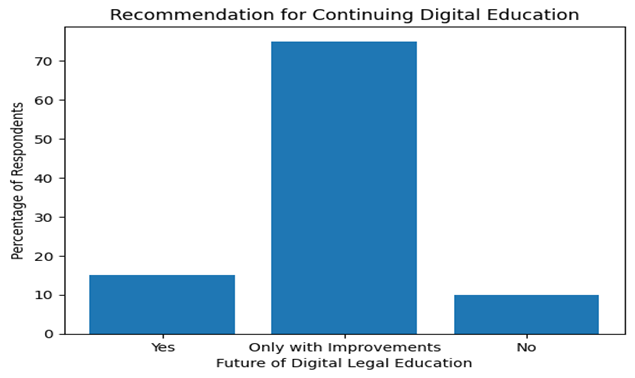
- Yes: ~15%
- Only with Improvements: ~75–80%
- No: ~10%
In fact, from the information gathered, it is clear that there is some sort of acceptance of the digital legal education in an “if and when” approach where most of the participants (75-80%) would accept the digital legal education if there were some sort of changes done to digital education. There are a few who either fully accept the idea of digital education (~15%) or totally reject it (~10%). The information provided gives us one interesting insight into the question at hand and that is that while it is clear that digital education is something that cannot be totally accepted or totally rejected. This is because digital education is a paradigm that will only live if there are some changes made to make the numerous issues within digital education acceptable. It can clearly be seen that there are a number of things that need to be changed regarding digital legal education such as lack of practical knowledge etc.
The non-doctrinal method has been employed in this paper through collecting primary data via structured questionnaires using Google forms. The data was collected from 76 law students who are pursuing various courses from BA (LAW) to LLB and LL M. The descriptive statistics technique would be employed in analyzing the collected data to find out what the students think regarding online legal education and regulatory issues surrounding the process.
Based on the findings in the study, it has been found out that approximately 68% of the respondents have regular access to the internet while 27% experience the challenge of having inconsistent connectivity, and only 5% lack internet access completely. The main idea that the research has brought out is that the issue of the digital divide has shifted from merely accessing the internet to having reliable connections.
With respect to the medium used, the majority of the respondents (72%) use their mobile phones while 28% prefer to use laptops or other devices such as tablets. This extensive use of mobile phones is due to the constraints of the online environment. Mobile phones can provide basic participation in online classes, but cannot provide enriched learning tools, such as having access to the full legal database and the skill of drafting.
As for the effectiveness of the digital delivery, around 40% of participants considered digital learning to be effective while 20% considered it to be highly effective. At the same time, 30% found it neutral while 10% found it ineffective From the findings, one may deduce that even though digital learning has gained practical recognition, it still falls short of achieving pedagogical recognition. The presence of a neutral group indicates skepticism among the students regarding its ability to provide substantive learning experiences.
Also, according to the data, the offline and blended methods continue being the leaders in terms of students’ preferences, since nearly 45% of all participants prefer offline education, while 40% select blended one and only 15% choose digital education. It may also stem from the fact that legal education has a practical aspect, requiring personal presence, simulations, teamwork, etc.
One of the main issues revealed through the questionnaire survey was that the vast majority of respondents (up to 80-85% of them) believe that digital education has a negative impact on practical classes including moot courts, internship, and client counseling classes. It is yet another important issue related to digital legal education because legal education is essentially based on experiential learning.
Furthermore, there has been a higher uptake of AI-based systems, where approximately 80% of the student respondents reported using such systems to conduct research and writing work. Although this can be viewed as an indication of technology making its way into law education, this situation brings further challenges associated with academic integrity and originality since there are no guidelines for the proper use of these technologies.
Concerning regulatory knowledge, around 30% of the student respondents held the view that adequate regulatory mechanisms existed in the realm of digital law education, while 45% disagreed and 25% were uncertain. This shows a lack of regulation, which can also be observed from the “regulatory lag” concept.
Another concern raised by the survey was that of data protection. While more than half of the respondents feared about their data safety with almost one-fifth considering their data unsafe. The matter of concern mentioned above holds significance in today’s scenario owing to the recent ruling that privacy is a fundamental right as per the decision made in the case of Justice K.S. Puttaswamy v. Union of India.
Furthermore, there have been many concerns regarding the fairness of the online tests. While 25% consider online tests as a fair mode of assessment, 35% view it as an unfair system and 40% remain indifferent to it.
Fourthly, there seems to be a somewhat reluctant approach to digital education, since about 75-80% of those surveyed would be willing to proceed with digital education only after considerable changes took place. About 15% of the participants in the survey were completely for digital education, while another 10% were completely against it. It is evident from this fact that digital legal education cannot be considered objectionable in principle, since it will depend on necessary reforms to overcome the issues arising in digital education.
To conclude, it can be stated that empirical evidence proves the main hypothesis of the present study – namely, while digital education offers more innovation and flexibility with the use of technology, it cannot be denied that it brings certain shortcomings along with itself, and these need to be addressed appropriately through regulatory measures.
9. Reforms and Policy Recommendations
From the above analysis of the problem and results of the study, there is a great need for coming up with an effective regulatory framework for digital legal education in India. Another area which requires urgent intervention is the restructuring of the existing legal framework established by the University Grants Commission and the Bar Council of India, considering that the technology has been evolving so fast.[3] [4]
The first step that should be taken is that of developing a framework for digital legal education. This would go a long way in addressing the question of establishing terms and conditions as well as setting minimum standards for quality assurance.
In the second place, it is essential that there should be regulations concerning the use of Artificial Intelligence in educational institutions. This would include formulating the guidelines regarding the use of the technology, developing methods against plagiarism, and adopting ethical standards in academic environments.
Lastly, it is imperative that the problem of the digital divide should be taken into consideration so that access to legal education through digital means should be equally available to everyone. This would include providing proper digital connectivity in far-flung areas, affordability of the technology to all people, and accessibility of digital devices. This is in line with the vision of the National Education Policy 2020.[5]
In addition, there is an essential need to create guidelines for protecting data within the education sector. It should be mandatory for the schools and EdTech firms to adhere to informed consent, principle of purpose limitation, and data security in line with Article 21 of Justice K.S. Puttaswamy v. Union of India, whereby privacy is considered a fundamental right. There is a need to formulate guidelines that regulate the acquisition, storage, and use of learners’ private information.
Further, there is a need to effectively regulate EdTech firms. This can be achieved through licensing, auditing, and ensuring that the quality of the courses offered, instructors’ credentials, and payment are clear.
Fourthly, the Bar Council of India will have to reconsider the current rules regarding legal education that will allow the flexibility in the digital method, or even the hybrid method. Students’ acceptance of online classes, attendance, and changes in teaching methodology (including moot courts and clinical legal education) should be considered. Finally, these measures will bring balance between innovation and regulation. It is an ideal state to reach for the development of digital legal education
- Conclusion
The shift in the nature of education through digital means is a paradigm shift in the form, process and accessibility of higher education in India From the findings of the study, it can be concluded without any doubt that the introduction of digital technology into the field of education has opened up new avenues for education, offering new ways to gain knowledge through various online technological means, artificial intelligence, and digital platforms. Nevertheless, the revolution itself has some limitations.
Through the examination of the doctrinal, comparative, judicial, and empirical approach, it can be observed that digital education in the legal field in India remains in its developmental stage. While the implementation of digital education in India is currently functioning with regard to its flexibility and accessibility, it remains illegitimate owing to the persistent existence of issues like the digital divide, dependence on mobile devices, absence of practical learning, and privacy issues of data collection.
From this empirical research, it is evident that students are not against technology-driven legal education in all ways; rather, they favor a blend of both modes of education. This clearly indicates that the future of legal education is neither going to disregard traditional systems of education nor going to favor technology at all, but instead it will be an ideal balance between both.
As far as making laws regarding digital legal education is concerned, it would be pertinent to state here that there is a large gap between advancements in technology and legal measures required to regulate those innovations. Consequently, it should be noted that the UGC and Bar Council of India must design their policies for handling matters related to AI, managing online education, and ensuring privacy of student data. It is also imperative to mention here that privacy has been recognized under the constitution in Justice K.S. Puttaswamy v. Union of India.
As per the analysis done above, it is safe to conclude that although the introduction of digital learning is an essential part of the modern legal education system, without implementing an appropriate regulatory framework, it might not be successful. It will be essential to maintain a perfect balance between innovation and accountability, accessibility and quality, and technology and the constitutional principles of law in order to ensure that the growth of the legal education system in India is progressive.
[1] OECD, Artificial Intelligence in Education, 2021.
[2] Puttaswamy v. Union of India, supra note 1.
[3] University Grants Commission, Guidelines on Online Education, 2020.
[4] Bar Council of India, Rules of Legal Education, 2008.
[5] Government of India, National Education Policy 2020, 2020.
[1] Justice K.S. Puttaswamy v. Union of India, (2017) 10 SCC 1.
[2] Mohini Jain v. State of Karnataka, (1992) 3 SCC 666.
[3] Unni Krishnan v. State of Andhra Pradesh, (1993) 1 SCC 645.
[4] Anuradha Bhasin v. Union of India, (2020) 3 SCC 637.
[5] Puttaswamy v. Union of India, supra note 1.
[6] Internet and Mobile Association of India v. Reserve Bank of India, (2020) 10 SCC 274.
[7] UNESCO, Education in a Post-COVID World, 2020.
[8] Mohini Jain v. State of Karnataka, (1992) 3 SCC 666.
[9] Unni Krishnan v. State of Andhra Pradesh, (1993) 1 SCC 645.
[10] Anuradha Bhasin v. Union of India, (2020) 3 SCC 637.