
Tanishka Jitendra
LLM(ADR), School of Law, at Gitarattan School of International
Business, Rohini, Delhi (Affiliated by GGSIPU)
Abstract
Rise of Alternative Dispute Resolution (ADR)
Alternative Dispute Resolution (ADR) has become an increasingly popular trend in civil litigation. ADR refers to a range of processes that offer alternatives to traditional litigation, such as mediation, arbitration, and negotiation.
One of the primary benefits of ADR is that it can be faster and less expensive than traditional litigation. ADR can also offer more privacy and confidentiality, as proceedings are not public record, and parties can agree to keep the details of the case confidential. Furthermore, ADR can help preserve relationships between parties by allowing them to work together to reach a mutually beneficial resolution.
However, ADR is not without its drawbacks. One of the main concerns is that it can lead to outcomes that are less predictable and less legally binding than traditional litigation. Additionally, some critics argue that ADR can be biased in favour of the stronger party or the party with more resources.
Examples of ADR in civil litigation include court annexed mediation, private mediation, and arbitration. Court annexed mediation is where the court orders parties to participate in mediation to try and reach a settlement. Private mediation involves parties agreeing to hire a neutral third-party mediator to help them reach a settlement. Arbitration is similar to a trial but takes place outside the courtroom and involves a neutral third-party arbitrator who makes a final, binding decision
Alternative Dispute Resolution (ADR) has emerged as a vital and reliable mechanism for resolving disputes outside the traditional courtroom framework. ADR had always been a dispute resolution from the very beginning. But it is emerging as an integral part of the judiciary in recent times. It is not a new concept, but it being speed up in recent years that it indicates that it is a new concept. Through the socio-legal lens, the potential of ADR in addressing commercial, matrimonial, and community-based conflicts may be explored. The legislative and judicial developments together highlight India’s commitment to bringing its arbitration regime in line with international standards, thereby creating a strong and investor-friendly arbitration environment.
Emerging Trends in Domestic Arbitration in India, are evolving rapidly, moving toward institutionalization, increased technology adoption, and enhanced emergency relief measures, while still struggling with high judicial intervention, the prevalence of ad-hoc arbitration, and enforcement delays. The trends in domestic arbitration include stricter timelines, artificial intelligence (AI) integration, emergency arbitration and a push for specialized arbitration benches.
Emerging Trends in International Commercial Arbitration in India, are defined by a strong pro-enforcement judicial approach, the adoption of institutional rules to expedite proceedings (notably the 2025 MCIA Rules), and increasing use of AI. The key trends include limiting judicial intervention, the rise of emergency arbitration, and a shift towards mediation for high-value government contracts. This article evaluates recent legislative and policy developments, including the push for institutional arbitration and the introduction of online dispute resolution. It highlights about the development in ICA, which is being growled in India as a hub for International Commercial Arbitration.
The Hon’ble former Chief Justice of India Shri SA Bobde had said AI “is a perfect blend of human intelligence and machine learning”. Integration of AI formally in Indian arbitration practice is only a matter of time and such a leading step would go a long way in making the country an arbitration hub as it has envisioned. Technology can act as a game changer, leading to a reduction in costs, making arbitration more accessible and affordable. This is in line with Government’s Vision 2030 wherein it aims to see arbitration space as a dynamic and amenable dispute resolution platform.
Key Words: ADR (Alternate Disputes Resolution), AI (Artificial Intelligence), ICA (International Commercial Arbitration)
Introduction
- Background:
The justice delivery process in the ordinary law courts is expensive, lengthy and cumbersome whereas speedy and inexpensive justice to people is very important and this fundamental right of timely access to justice is based on the latin maxim “Ubi jus ibi remedium” (where there is a right there must be remedy). Further it should also be kept in mind that “Justice hurried is justice burried”, so the speedy justice mechanism has to be very well thought of and based on principles of natural justice. Focus should be on the ultimate and final resolution of dispute and not just a case. Search for the solution to this problem led to the advent of Alternative Disputes Redressal system to reduce the workload of main justice delivery system. One of the major modes in alternative dispute redressal mechanism is arbitration.
The traditional arbitration process in India has been a long-standing alternative to formal judicial proceedings, offering parties a more private and often faster method of resolving disputes. Traditionally, arbitration involves a neutral arbitrator or panel who hears both sides before reaching a decision, with less formality and more flexibility compared to the court system. However, despite its intended efficiency, traditional arbitration in India has sometimes been marred by procedural delays, high costs, and limited accessibility, particularly for those in remote areas.
The law in India related to arbitration has been gradually evolving to satisfy the needs of the Indian economy. The main intent of the Indian legislature while implementing arbitration laws in India is to elevate arbitration as the preferred mode at both the international and national levels. There is a catena of pro-arbitration judgments and legislative amendments in Indian arbitration law to make India a pro-arbitration regime.
The major law governing domestic and international arbitration in India is Arbitration and Conciliation Act, 1996 which is based on UNCITRAL Model law of arbitration and rules of conciliation. After two decades from the enactment of this Act, government has introduced series of amendments in this Act vide 2015, 2019 and 2021 amendment acts with a view to make India a convenient place for international arbitration and business and to make arbitration speedy method of alternative dispute resolution.
Even after fixing the time limit for resolution of disputes through arbitration method by arbitrator or arbitral tribunal, arbitral award can be challenged under various wide and vague grounds stated under amended Section 34 of Arbitration Act or under amended Section 36 of the Act at the time of enforcement of awards also where the matter remains pending in courts for years thereby nullifying the effect of speedy dispute redressal and depriving the parties to dispute from the fruits of arbitral award.
Emerging trends in India’s Alternative Dispute Resolution (ADR) focus heavily on technology integration (ODR, virtual hearings), strengthening institutional arbitration, and significant legislative reforms (Amendments 2015, 2019, 2021) to boost efficiency, transparency, and enforceability, moving towards a digital, streamlined, and globally aligned ADR ecosystem for faster justice. Key developments towards this include promoting mediation, emergency arbitration, expanding arbitrator qualifications, and utilizing platforms like e-Courts and Presolv360 for accessible, cost-effective resolution, especially post-COVID-19.
With the world navigating rapid technological advancement and experiencing the introduction of Artificial Intelligence (“AI”), the arbitration community has witnessed a shift to Online Dispute Resolution (ODR), inclusion of ESG-based claims and an increase in Insolvency and restructuring cases, including shareholder disputes as well. This shift not only welcomes technological innovation in Arbitration and Mediation but also reflects global commercial realities and emphasizes the need to shift to other methods of dispute resolution which are not only convenient, but also cost and time effective for the parties. This article aims to identify and address the upcoming trends in commercial disputes by comprehensively assessing them and gauging their impact on the parties.
The emergence of online arbitration platforms and initiatives is transforming dispute resolution in India, providing new tools and methods for handling cases remotely. Online arbitration allows the parties to conduct hearings, submit evidence, and receive decisions entirely online, which has proven invaluable in a country with significant caseloads and backlog issues. Platforms like Presolv360 and ODR ways have introduced digital solutions that streamline the arbitration process, providing services such as digital document submission, virtual hearings, and AI-assisted analysis of case documentation. These online systems are particularly advantageous in reducing travel requirements, minimizing delays, and offering quicker resolutions, making them a highly accessible option for individuals and businesses alike.
India’s legal and regulatory framework has evolved to support the rise of online arbitration, with key legislations adapting to accommodate technology-driven dispute resolution. The Arbitration and Conciliation Act, 1996, amended multiple times, remains the primary legislation governing arbitration, incorporating provisions to facilitate faster and more efficient arbitration processes. Additionally, the Information Technology (IT) Act, 2000, plays a crucial role in regulating electronic records, digital signatures, and the legality of online agreements and transactions, thereby creating a supportive legal environment for online arbitration.
Furthermore, the courts have been proactive in promoting the use of technology in dispute resolution; for example, recent judicial pronouncements have encouraged the use of online and virtual hearings to ensure continuity and accessibility during the COVID-19 pandemic. In this evolving landscape, online arbitration represents a promising shift towards accessible, efficient, and cost-effective dispute resolution. However, challenges such as data security,
user privacy, and technological infrastructure still need to be addressed to ensure the full potential of online arbitration in India.
Recent judicial trends in India have shaped the landscape of domestic arbitration. Courts have emphasized the importance of party autonomy and non-interference in arbitration proceedings. Additionally, there has been a push towards expediting arbitration proceedings and minimizing delays through strict adherence to timelines. The Supreme Court’s pro-arbitration stance and its efforts to streamline arbitration procedures have bolstered confidence in domestic arbitration as a viable dispute resolution mechanism.
- Mode of Dispute Resolution
The traditional method i.e. court proceedings has seen a gradual change. Some changes have been made even to ease the pressure on courts (back log of cases) by the setting up of new forums (specialized courts and tribunals). Under this head we will look at some of the changes that have taken place in the mode of dispute resolution like litigation (commercial courts act, class action), arbitration (amendments to arbitration act) and new tools like mandatory pre-suit mediation and online dispute resolution
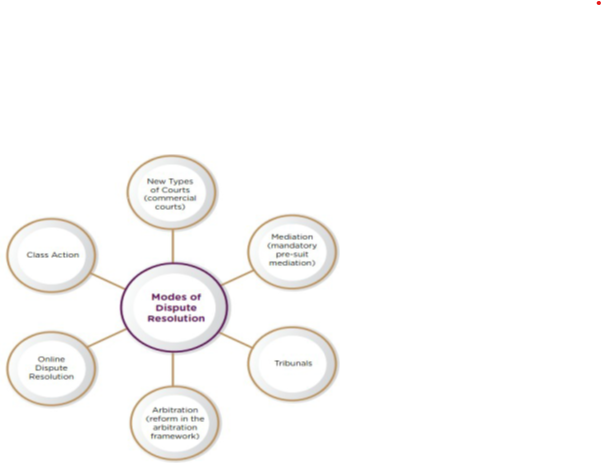
This aspect has seen a gradual change. The traditional method of dispute resolution like litigation and alternative dispute resolution mechanism have remained the same, however the Hon’ble Apex Court has introduced urgent reforms in these areas to ensure speedy and new ways of resolving disputes.
Setting up of Commercial Courts: Litigation is time consuming and has placed pressure on the court system. In order to address the issue of pendency of cases, the government introduced the commercial courts act, which contemplates time-bound resolution of commercial disputes by judges with specialized commercial expertise.
Arbitration: is an efficient method of dispute resolution, however there has been interference by Indian courts in arbitration matters on a variety of issues. This has been coupled with the fact that most domestic arbitrations were ad-hoc arbitration.
With the uncertainty in the law relating to arbitration and the constantly changing legal regime the law commission suggested major reforms to the Indian arbitration act. The amendments to the arbitration act include strict timelines for completion of arbitration proceedings, reduced judicial interference in the process and making enforcement of the arbitral award easier.
Mediation: has emerged as an important tool to resolve commercial disputes in an amicable manner. The government has introduced an amendment in the commercial courts act which mandates a pre-suit mediation in commercial disputes. However, this amendment does not apply in cases where a party is seeking urgent interim relief. The government has also sought to make the mediation process more meaningful by making the settlement agreement arrived at between the mediating parties enforceable in the same manner as an arbitral award.
Tribunals: have emerged as an important parallel structure to the court system for quick and technical resolution of disputes in certain areas of law. The government set up tribunals in different sectors like telecom, environment, anti-trust, electricity because of globalization and the development of technology.
Online Dispute Resolution: is an alternative dispute resolution technique that uses the internet as an interface to resolve disputes. The use of online techniques in the dispute resolution process such as submission of pleadings through email, videoconferencing for case hearings etc. facilitates convenient, cost-effective and expeditious resolution of disputes. Even though online dispute resolution may include the mechanisms of institutional alternative dispute resolution it is a step further for fast-track dispute resolution. This has in some way been introduced in matrimonial and mediation matters.
Class Action suits: may be initiated in case of a mismanagement of a company and may be filed by a class of shareholders. Though class action has been introduced in the companies act a few years back but it has not taken off as in other jurisdictions. The courts have generally been pro-reform. While the modes of dispute resolution have changed gradually, however due to the emergence of new technology and new areas requiring regulation, the government has introduced reforms in the modes of dispute resolution to address the growing needs of the economy. While the specialized tribunals, mandatory pre-suit mediation, reform in the arbitration framework and the commercial courts have reduced the burden on the court system, however more needs to be done.
- The Alternative Dispute Resolution (ADR) and Online Dispute Resolution (ODR)
Alternate Dispute Resolution (ADR) has in recent times, not only become a cornerstone in the management of commercial disputes but has also established itself as an essential boilerplate clause in commercial contracts due to its confidentiality, timeliness and cost-effective nature. It becomes the most sought-after dispute resolution mechanism due to its flexible nature and provides the parties with the utmost autonomy of appointing their arbitrators, choosing the seat and venue of the arbitration and deciding the arbitration procedure itself. The Arbitration and Conciliation Act, plays a key role in providing the parties with such great autonomy, by stating the very words “unless the parties choose otherwise”. However, whenever the parties are indecisive about the panel’s composition, this section gives them the opportunity to file an application before the High Court to appoint the panel. Thus, the procedure not only establishes specialized commercial courts and tribunals but at the same time also provides the disputing parties with the option to seek other ADR methods, thereby reducing the backlogs from the courts, offering a more accessible and convenient way to resolve disputes. Further, while arbitration still remains a court-driven process, Mediation, on the other hand, has been gaining much prominence amongst commercial parties due to its focused approach in negotiations and favourability to the parties. This can be seen from the introduction of the Mediation Act, 2023, which aims to promote and facilitate institutional mediation. It also introduces Online Mediation Mechanisms which is cost-effective and results in faster resolution of disputes in comparison to court-based litigation. Mediation has gained further impetus under Section 12A of the Commercial Courts Act, 2015 and Section 89 of the Code of Civil Procedure, 1908, which mandate pre-suit mediation settlement agreements enforceable like arbitral awards.
- Emerging Trends in Arbitration:
- Emerging Trends in Domestic Arbitration: In India trends in domestic arbitration are evolving rapidly, moving toward institutionalization, increased technology adoption, and enhanced emergency relief measures, while still struggling with high judicial intervention, the prevalence of ad hoc arbitration, and enforcement delays. The key trends in domestic arbitration include stricter timelines, artificial intelligence (AI) integration, and a push for specialized arbitration benches.
Emerging Issues:
Ad Hoc vs. Institutional Arbitration: Despite efforts to promote institutions, most of the stakeholders still prefer ad hoc arbitration. However, there is a growing demand for specialized, efficient institutional frameworks.
Judicial Intervention and Finality: Despite the 2015/2019 amendments aiming for minimum court interference, high rates of challenge (Sections 34 and 37) and setting aside of awards create uncertainty. Courts sometimes overstep, even modifying awards instead of just setting them aside.
Emergency Arbitration (EA): Gaining popularity for time-sensitive, high-stakes disputes (e.g., Amazon v. Future Group1).
Technology Adoption: Increased use of technology and AI is being explored for faster, more transparent proceedings, though its full impact on arbitration, such as virtual hearings, is still evolving.
Limitation Periods: Legal clarity is still evolving on, for instance, when the limitation period starts (e.g., as per M/S Arif Azim Co Ltd v. M/S Aptech Ltd2, it starts with the valid notice of invocation).
Key Trends & Developments:
1. Digital Transformation & ODR:
Online Dispute Resolution (ODR): Rise of digital platforms for mediation, arbitration, and negotiation, offering convenience, accessibility (anywhere participation), and time efficiency.
Virtual Hearings: Accelerated by the pandemic, virtual proceedings are now standard for remote participation.
Digital Initiatives: Integration with government projects like e-Courts.
- CIVIL APPEAL NOs. 4492-4493 OF 2021
- 2024 (SC) 180
2. Legislative & Institutional Reforms:
Amendments to Arbitration Act: 2015, 2019, and 2021 amendments aim to reduce delays, ensure arbitrator neutrality, minimize judicial interference, and improve award enforcement.
Institutional Arbitration: Strong push towards organized institutions (like IIAC- to oversee processes an DIAC), replacing ad-hoc arbitration.
3. Focus on Mediation:
Court-Annexed Mediation: Establishment of mediation cells at various levels (district, state, national).
Mandatory Mediation: Introduced under acts like the Commercial Courts Act, 2015, for certain disputes.
4. Capacity Building & Standardization:
Arbitrator/Mediator Training: Efforts to enhance quality through formal accreditation and licensing.
Clearer Qualifications: Amendments expanding who can be an arbitrator.
5. Judicial & Policy Support:
Supreme Court Promotion: Judgments emphasizing ADR’s importance (e.g., Afcons Infrastructure).
Government Initiatives: Policy and legislative efforts to make ADR more efficient and a viable alternative to litigation.
Key Challenges to Address:
• Enforcement Delays: Difficulty in quick enforcement of domestic and foreign awards.
• Arbitrator Expertise: Concerns over the consistency of arbitrator expertise.
• Lack of Awareness: Limited understanding of alternative dispute resolution (ADR) among rural and smaller business entities.
- Emerging Trends in International Commercial Arbitration in India, are defined by a strong pro-enforcement judicial approach, the adoption of institutional rules to expedite proceedings (notably the 2025 MCIA Rules), and increasing use of AI. Key trends include limiting judicial intervention, the rise of emergency arbitration, and a shift towards mediation for high-value government contracts.
- Institutional Shift & Efficiency: The Mumbai Centre for International Arbitration (MCIA) introduced 2025 Rules featuring expedited procedures, early dismissal of unmeritorious claims, and joinder of non-parties. The SIAC 7th Edition Rules (2025) also affect Indian parties with enhanced emergency arbitration.
- Pro-Enforcement Judiciary: Indian courts are increasingly adopting a “minimalist” role in reviewing foreign awards, focusing on limited, substantive grounds under the Arbitration and Conciliation Act (ACA).
- Mediation Over Arbitration for Public Projects: The government is encouraging mediation for large, high-value public procurement disputes, restricting arbitration for such matters.
- BIT Arbitration Nuances: The Delhi High Court confirmed that Bilateral Investment Treaty (BIT) arbitrations fall outside the scope of the Indian Arbitration Act (1996), maintaining distinct procedures for treaty-based disputes.
Global Trends Impacting India:
- AI Integration: The use of AI in arbitral proceedings is rising, prompting questions about confidentiality and procedural fairness.
- Third-Party Funding (TPF): Regulation of third-party funders is increasing, with specific focus on transparency regarding the funding source.
- Sustainability Disputes: Growing numbers of disputes relate to environmental impact and climate change concerns in energy and construction industries.
- Emergency Arbitration (EA): Gaining popularity for time-sensitive, high-stakes disputes (e.g., Amazon v. Future Group), with over 80% supporting its formal, wide spread adoption. However, The Arbitration and Conciliation Act, 1996 still do not have provisions with respect to the Emergency Arbitration, though, the Emergency Arbitration orders have been recognised through judicial pronouncements.
Statement of Research problem
The emerging trends in Alternative Dispute Resolution (ADR)—such as Online Dispute Resolution (ODR), emergency arbitration, and specialized mediation—aim to modernize dispute settlement but face significant structural, technical, and cultural hurdles. The core statement of the problem lies in the gap between the theoretical efficiency of ADR and its practical implementation, where rising costs, procedural bottlenecks, and lack of enforcement mechanisms often mirror the traditional litigation it is meant to avoid.
Statement of Problem: Core Challenges:
- Institutional and Procedural Bottlenecks: Despite legal frameworks (like the Arbitration and Conciliation Act, 1996, in India), ADR proceedings are increasingly criticized for becoming slow, formalistic, and as expensive as conventional litigation, reducing their effectiveness.
- Enforcement Deficiencies: A major challenge is the lack of quick and uniform enforcement of arbitral awards and mediated settlements. Arbitral awards are frequently contested, leading to lengthy court delays that undermine the “finality” of the ADR process.
- Lack of Specialized Professionals: There is a shortage of qualified, neutral, and dedicated arbitrators and mediators. Frequently, retired judges operate in ADR with the same “adversarial” mindset as traditional courts, preventing flexible, “win-win” outcomes.
- Technological and Security Risks (ODR): While ODR is rising, particularly post-COVID-19, challenges include inadequate digital infrastructure, cybersecurity threats, data privacy concerns, and the lack of a comprehensive legal framework for virtual hearings.
- Resistance and Lack of Awareness: ADR suffers from low awareness among the general public and a cultural resistance among lawyers and litigants who prefer the familiarity of traditional court trials, leading to underutilization.
- Power Imbalances in Emerging Areas: In areas like consumer and employment disputes, the increased use of binding arbitration clauses can disadvantage weaker parties, raising ethical questions about due process.
Impediments of Emerging Trends :
- Online Dispute Resolution (ODR): Rapidly growing but hindered by digital divides and security concerns.
- Emergency Arbitration: Used to protect assets before a tribunal is formed, but often complex and expensive, creating “an illusion of emergency relief”.
- Intellectual Property (IP) ADR: While promising, it faces challenges regarding the arbitrability of certain rights and the need for high-level technical expertise.
Hypothesis
Emerging trends in Alternative Dispute Resolution (ADR) are currently shaped by the rapid adoption of technology (ODR), the push for institutionalization, and the diversification of ADR into specialized fields like IP and sustainability. Research in this area is largely driven by the hypothesis that while ADR is crucial for reducing judicial backlogs and providing efficient justice, its potential is often hampered by systemic, technological, and cultural challenges.
Key hypotheses regarding emerging trends in ADR:
1. Technological Integration and ODR (Online Dispute Resolution)
- Hypothesis: The integration of AI, blockchain, and digital ODR platforms enhances the efficiency, accessibility, and cost-effectiveness of ADR, transforming it from a traditional voluntary mechanism into a primary, tech-enabled mode of justice.
- Sub-Hypothesis: While ODR offers speed and remote access, its effectiveness is limited by digital infrastructure gaps, data security concerns, and user trust in developing nations.
- Impact: Post-COVID-19, virtual mediation and online arbitration are no longer just temporary solutions but are becoming standard, creating “hybrid” models of resolution.
2. Institutionalization and Professionalization
- Hypothesis: The shift from ad hoc arbitration to institutional arbitration ensures greater procedural transparency, consistency in outcomes, and reduced judicial interference.
- Sub-Hypothesis: The shortage of certified and skilled mediators and arbitrators is the primary obstacle to the credibility and widespread adoption of ADR in developing markets.
- Trend: Emergence of specialized institutions (e.g., Singapore International Mediation Centre) to manage complex commercial and cross-border disputes.
3. Expansion into Specialized Sectors
- Hypothesis: Specialized ADR, particularly mediation and arbitration, is increasingly favoured over traditional litigation for resolving intellectual property (IP), corporate, and environmental disputes because it preserves business relationships and ensures confidentiality.
- Trend: High usage of emergency arbitration in corporate contracts for rapid interim relief before a tribunal is formally constituted.
4. Cultural and Legal Acceptance
- Hypothesis: Despite legislative reforms promoting ADR, cultural resistance—viewing compromise as a weakness—and a lack of awareness restrict its full potential, necessitating a shift towards a “multi-door” courthouse approach.
- Trend: Strengthening of legal frameworks (e.g., Singapore Convention on Mediation) to ensure the enforceability of mediated settlements, making them as binding as court judgments.
5. Socio-Legal Barriers
- Hypothesis: The success of emerging ADR trends is highly dependent on overcoming socio-economic barriers, such as the urban-rural divide in access to digital infrastructure and trained professionals.
Research Methodology
As ADR evolves with technology and becomes more institutionalized, research methods now focus on evaluating the efficiency, accessibility, and technological integration of Online Dispute Resolution (ODR), Artificial Intelligence (AI) in arbitration, and mediation. Statutory provisions, amendments (e.g., Arbitration and Conciliation Amendments), case laws from Supreme/High Courts, and institutional reports (e.g., NITI Aayog ODR reports).
Crytical Analysis
Alternative Dispute Resolution (ADR) has evolved from a simple voluntary alternative into a crucial, increasingly mandatory, and highly technologized component of modern justice systems, aimed at reducing the backlog of cases. Emerging trends such as Online Dispute Resolution (ODR), Emergency Arbitration, and AI-driven mediation offer increased efficiency, cost-savings, and global accessibility. However, this evolution brings significant, critical challenges, including the digital divide, data privacy concerns, the potential “judicialization” of arbitration, and the danger of power imbalances in mandatory mediation.
1. Key Emerging Trends in ADR
- Online Dispute Resolution (ODR): The most significant shift, accelerated by COVID-19, enables virtual hearings, electronic filing, and automated case management, breaking geographical barriers.
- Mandatory Pre-Litigation Mediation: Legislative changes (e.g., in India, the Commercial Courts Act, 2015) make mediation a mandatory step before filing certain commercial lawsuits, aiming for early settlement.
- Emergency Arbitration: A rapid, temporary arbitration mechanism for urgent interim relief before a full tribunal is formed, recognized in high-stakes cases (e.g., Future Retail v. Amazon). The court held that there is nothing mentioned in the Arbitration and Conciliation Act 1996, which prohibits enforcement of an emergency arbitral award obtained from a foreign forum in India. Emergency arbitration is a mechanism by which a disputing party applies for the emergency or urgent interim relief, before an appropriate arbitration tribunal is formally set up. The relief obtained from the emergency arbitration is subject to challenge before the appropriate arbitration tribunal, however the interim emergency relief can also be regarded as final award if the other party does not challenge it.
Neither in the original 1996 Act nor in the 2015 Amendment, is there any mention of emergency arbitrations and their fate. This has created a problem in determining the disputes relating to the recognition and enforcement of such reliefs before Indian courts. Moreover, there is no specific mention of emergency arbitrations under the New York Convention 1958, which has worsened the situation for Indian Courts since there is no prescribed way of how to go about in cases involving validity and enforcement of emergency arbitral awards.
The practice of emergency arbitration is well developed over the years with almost all the major arbitration centres including Indian centres providing such a mechanism in their rules. Moreover, many countries such as Singapore and Hong Kong have already implemented laws relating to the enforcement and recognition of emergency arbitrations. However, in India there is no legal provision recognising such a proceeding.
The 246th Law Commission Report recommended expansion of the definition of “arbitral tribunal” by including an award/relief rendered in an emergency arbitral proceeding as well, but it could not find a place in the legislation. However, with this judgment of the Delhi High Court, it seems that the focus would be on amending the Arbitration and Conciliation Act to fill such a gap in the arbitration law of India.
- AI and Data Analytics in ADR: AI is increasingly used to analyze complex, large-volume documentation and, in some cases, predict case outcomes to streamline the decision-making process.
- Institutional Arbitration Shifts: The rise of specialized institutions (e.g., Mumbai Centre for International Arbitration) is reducing ad-hoc arbitration, offering structured, specialized, and reliable procedures.
2. Critical Analysis of Emerging Trends:
A. ODR and Technological Advancement
- Pros: Improved accessibility and speed, reduced environmental impact due to less travel, and cost-efficiency.
- Cons/Risks: The digital divide restricts access for rural or economically disadvantaged parties. Concerns regarding the security of digital evidence and the confidentiality of online platforms are significant. Furthermore, virtual hearings may lack the nuance of in-person communication, impacting the ability of mediators to build trust.
B. Mandatory Mediation: Access to Justice or Coercion?
- Critique: While mandatory mediation increases the chances of settlement, it can be viewed as an infringement on the voluntariness of the process. Critics argue that forcing parties to mediate can lead to perfunctory participation rather than genuine negotiation.
Power imbalances can be exacerbated if a weaker party is coerced into a bad settlement to avoid the “mandatory” tag.
C. Judicialization of Arbitration
- Trend: Arbitration is increasingly becoming more similar to litigation (procedural technicality, higher costs) than to informal, flexible resolution.
- Critique: High arbitrator fees and the increasing trend of appointing legal professionals rather than industry experts can make arbitration as expensive and slow as formal court litigation. The 2021 Amendment to the Arbitration and Conciliation Act in India, which allows for an automatic stay on awards if they are tainted by “fraud” or “corruption,” has been criticized for increasing court intervention, thus undermining the finality of awards.
D. Need for Regulatory Frameworks and Training
- Critique: The rapid growth of ADR lacks uniform training and certification standards for mediators and arbitrators, leading to uneven quality of justice. There is an urgent need for statutory recognition and comprehensive legal frameworks governing ODR platforms and AI tools to ensure ethical standards and enforceability.
3. Conclusion: The emerging trends in ADR show a promising shift towards a more efficient and accessible justice system, particularly through technology and institutionalization. However, the critical challenge lies in maintaining the core strengths of ADR—flexibility, speed, and fairness—while addressing the new perils of digital disparity, commercialization, and reduced voluntariness. To fulfill its potential, ADR must continue to evolve as a truly alternative mechanism rather than a “junior” court system.
Conclusion and Suggestion
The emerging trends in Alternative Dispute Resolution (ADR) indicate a significant shift towards technology-driven, institutionalized, and faster dispute resolution mechanisms, moving away from traditional ad hoc arbitration. Key trends include the rise of Online Dispute Resolution (ODR), the use of artificial intelligence (AI) in case management, emergency arbitration, and the codification of mediation laws.
Conclusion:
- Shift Towards ODR and Technology: The COVID-19 pandemic accelerated the adoption of virtual ADR. ODR is now a reliable, flexible, and accessible method for resolving disputes remotely, particularly in e-commerce, consumer, and corporate matters.
- Institutionalization Over Ad Hoc Arbitration: There is a strong movement towards institutional arbitration (e.g., SIAC, MCIA) over ad hoc arbitration to ensure professionalism, predictability, and efficiency.
- Pro-Arbitration Judicial Approach: Judiciary in many jurisdictions is actively promoting ADR through court-annexed mediation and reducing interference in arbitral awards, supporting the finality of the process.
- Codification of Mediation: Recent legislation, such as the Mediation Act of 2023 in India, recognizes mediation as a structured, voluntary, and enforceable process, broadening its scope beyond family disputes.
- Focus on Specialized ADR: Growing use of specialized ADR for specific areas, such as investor-state arbitration, environmental disputes, and international commercial arbitration.
Suggestions for Further Development:
- Capacity Building and Accreditation: There is an acute need for structured training and formal accreditation for mediators and arbitrators to ensure high quality and consistency in ADR outcomes.
- Developing Institutional Infrastructure: Establishing more high-quality, specialized arbitral institutions, especially in developing regions, to promote institutional rather than ad hoc arbitration.
- Enhancing Public Awareness: Conducting public awareness campaigns to shift the cultural preference from litigation to mediation and conciliation, portraying them as dignified, “win-win” solutions rather than compromises.
- Standardizing ODR Protocols: Developing robust and secure ODR platforms with standardized rules to ensure confidentiality, data privacy, and enforceability of online awards.
- Regulating Fees: Implementing guidelines to regulate the fees of arbitrators and mediators to make ADR affordable for all sections of society, ensuring it does not become an exclusive option for high-value cases.
- Strengthening Enforcement: Streamlining the judicial enforcement process for arbitral awards and mediated settlements to prevent the misuse of appeal mechanisms to delay resolution.
- Integrating ADR in Curriculum: Introducing ADR methods as a core subject in legal education to foster a dispute-resolution-focused mindset among future legal practitioners.
References/Bibliography
Acts:
- Arbitration and Conciliation Act, No. 26 of 1996
- Arbitration and Conciliation (Amendment) Act, No. 3 of 2015.
- Arbitration and Conciliation (Amendment) Act, No. 33 of 2019
- Arbitration and Conciliation (Amendment) Act, No. 3 of 2021
Books:
- Law of Arbitration and Conciliation, By Avtra Singh, Eastern Book Company, Lucknow
Articles:
Enforcement of Arbitration Awards in India- by Sumeet Kachwaha*
Enforcement of foreign arbitral award in India- By Ginny Jetley Rautray*
Reports:
- United Nations General Assembly Resolution on the UNCITRAL Model Law
- Law Commission of India, Report No. 246 –Amendments to the Arbitration & Conciliation Act,
- Arbitration and Conciliation (Amendment) Act, No. 3 of 2015 (India).
Conventions:
- Geneva Convention, 1927.
- The Convention on the Recognition and Enforcement of Foreign Arbitral Awards, 1958.
Websites: