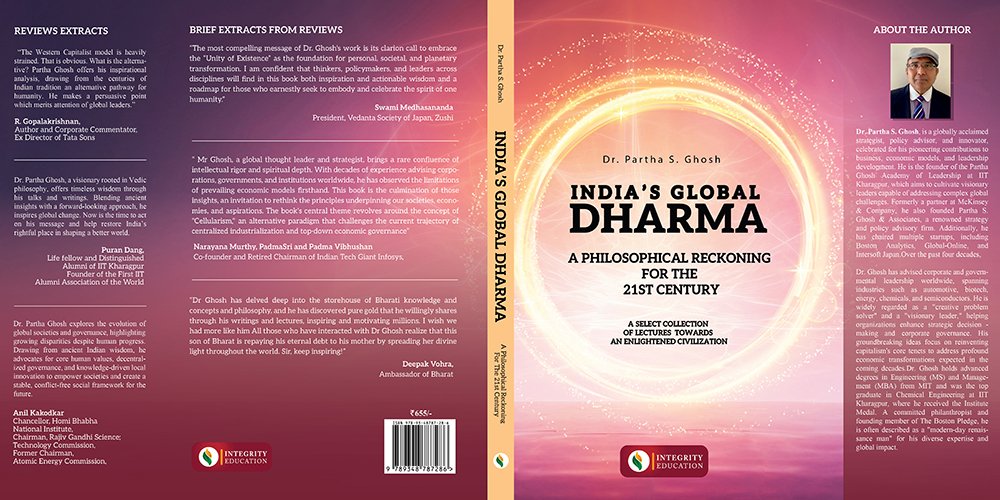

Mr Ghosh, a global thought leader and strategist, brings a rare confluence of intellectual rigour and spiritual depth. With decades of experience advising corporations, governments, and institutions worldwide, he has observed the limitations of prevailing economic models firsthand. This book is the culmination of those insights,
an invitation to rethink the principles underpinning our societies, economies, and aspirations.
The book’s central theme revolves around the concept of “Cellularism,” an alternative paradigm that challenges the current trajectory of centralized industrialization and top-down economic governance. Instead, it advocates for a bottom-up, locally empowered framework where communities become the building blocks of sustainable development. Cellularism does not reject globalization; rather, it seeks to balance global integration with local development, ensuring that economic progress does not come at the cost of social equity and environmental harmony.
At the heart of this vision is a fundamental shift in mindset, one that transcends the zero-sum dynamics of competition and exploitation in favour of a “plus-sum” model of collective progress.
The book eloquently argues for three transformative shifts:
- From “Power of Self-Interest” to “Power of Self Expression”: fostering a culture where purpose drives progress rather than individual greed
- From “Survival of the Fittest” to “Fitness of Nature”: shifting from exploitative, competition-driven systems to regenerative models that nurture sustainability and long-term harmony
- From a “Mechanistic, Cartesian” economic model to a “Biological, Organic” economic model: recognizing the interconnectedness of nature, humanity and economics and
structuring economic principles accordingly.
As India approaches its centenary of independence in 2047, this book positions the nation as a potential pioneer of a new global paradigm, one that blends technological innovation with ancient wisdom. It challenges India to seize the next five to seven years as a “strategic window of opportunity” to leapfrog traditional industrialization
models and lead the world toward a more equitable and sustainable economic order.
This book offers a unique synthesis of ideas that are both revolutionary and deeply rooted in timeless wisdom. It integrates lessons from history with forward-looking strategies, recognizing that humanity’s holistic progress cannot be driven solely by technological innovation. Instead, true transformation must be grounded in ethics and values. The principles laid out in these pages challenge us to question long-held assumptions about growth, success, and development, urging us to redefine progress in terms of well-being rather than material accumulation.
What makes this book particularly powerful is its call to action. It is not a theoretical exercise but a roadmap for a movement, a call for policymakers, business leaders, academicians, and the youth to build a deeply ethical, culturally rich, and economically inclusive future. As we stand on the precipice of transformation, Mr Ghosh reminds
us that technological advancement alone is insufficient; true progress requires “human-ware engineering”—the cultivation of values, behaviours, and ethics that respect time, nature, and relationships.