

Arshita Sharma[1]
Assistant Professor, University School of Law,
Rayat Bahra University, Mohali, Punjab, India.
Shagun Sharma[2]
Student of LLM, University School of Law,
Rayat Bahra University, Mohali, Punjab, India.
Abstract
Climate change has emerged as one of the most significant global challenges of the twenty-first century, posing serious threats to environmental sustainability, human rights, public health, and socio-economic development. In India, the adverse impacts of climate change, including rising temperatures, extreme weather events, floods, droughts, and ecological degradation, have intensified the need for effective legal and institutional responses. In the absence of comprehensive climate-specific legislation, the Indian judiciary has played a proactive role in addressing climate-related concerns through judicial activism and environmental jurisprudence. This paper critically examines the concept of climate justice in India with special emphasis on climate change litigation and the evolving role of courts in safeguarding environmental and constitutional rights. The study analyses how the judiciary has interpreted Articles 14, 21, 48A, and 51A(g) of the Constitution of India to expand the scope of environmental protection and sustainable development. It further explores the contribution of Public Interest Litigation (PIL) in promoting climate accountability and environmental governance. The research also evaluates the challenges associated with climate litigation in India, including policy gaps, enforcement issues, balancing economic development with ecological preservation, and the limitations of judicial intervention. By examining landmark judgments, national policies, and international climate obligations, the study highlights the growing significance of judicial mechanisms in advancing climate justice. The paper concludes that judicial activism has become an essential instrument for environmental protection in India; however, stronger legislative frameworks, institutional coordination, and public participation are necessary to ensure long-term climate resilience and equitable environmental governance.
Keywords; Climate Justice; Climate Change Litigation; Judicial Activism; Sustainable Development; Environmental Governance.
I. Introduction
The Global and National Context of Climate Change Climate change is undeniably the defining global crisis of our time, representing an unprecedented existential threat to human civilization, global economies, and natural ecosystems. Driven primarily by anthropogenic greenhouse gas (GHG) emissions since the industrial revolution, the rapid warming of the planet has triggered cascading consequences, including rising sea levels, extreme weather events, glacial retreat, and widespread biodiversity loss. Globally, the response has been anchored in scientific consensus, spearheaded by the Intergovernmental Panel on Climate Change (IPCC), and diplomatic negotiations culminating in landmark treaties such as the United Nations Framework Convention on Climate Change (UNFCCC) of 1992, the Kyoto Protocol of 1997, and the Paris Agreement of 2015. However, as the gap between international diplomatic commitments and actual emission reductions widens, global civil society has increasingly turned to the judiciary to enforce climate accountability, marking a paradigm shift from negotiation to litigation[1].
Within this global matrix, India occupies a unique and highly complex position. As a rapidly developing economy with a population exceeding 1.4 billion, India is the world’s third-largest emitter of greenhouse gases, although its historical contribution and per capita emissions remain significantly lower than those of industrialized nations[2]. Paradoxically, India is also one of the country’s most vulnerable to the adverse impacts of climate change. With an agrarian economy heavily dependent on the monsoon, a vast coastline threatened by rising sea levels, and Himalayan communities vulnerable to glacial lake outburst floods (GLOFs), the localized impacts of global warming in India are immediate and devastating[3]. India’s climate policy is thus characterized by a delicate balancing act: achieving rapid economic growth and poverty eradication while committing to ambitious climate targets, including reducing the emissions intensity of its GDP and achieving net-zero emissions by 2070.
Growth of Environmental Litigation in India to understand the emergence of climate change litigation in India, one must first look at the rich and robust history of Indian environmental jurisprudence[4]. The foundation for environmental protection was laid in the late 1970s and 1980s, catalyzed by the catastrophic Bhopal Gas Tragedy and the judicial innovation of Public Interest Litigation (PIL). The Supreme Court of India fundamentally transformed environmental governance by expansively interpreting Article 21 of the Constitution (Right to Life) to include the right to a clean, healthy, and pollution-free environment. Supported by the Directive Principles of State Policy (Article 48A) and Fundamental Duties (Article 51A(g)), the Indian judiciary adopted and indigenized key international environmental principles. Principles such as the “Polluter Pays,” the “Precautionary Principle,” “Intergenerational Equity,” and the “Public Trust Doctrine” were integrated into domestic law through landmark rulings in cases championed by environmentalists like M.C. Mehta. This era saw the courts intervening in localized issues of air and water pollution, illegal mining, and forest conservation. Furthermore, the establishment of the National Green Tribunal (NGT) in 2010 provided a specialized, fast-track judicial forum equipped with scientific expertise, further accelerating environmental enforcement across the country.[5]
Meaning of Climate Change and Climate Litigation
Climate shifts now shape much of today’s worldwide challenges, posing deep risks to societies, economies, and living systems across Earth. Since industry began expanding centuries ago, human activities have poured heat-trapping gases into the air – warming the planet at a pace rarely seen before[6]. That rise in temperature sets off chain reactions: oceans climb higher, storms grow fiercer, ice melts faster, species vanish more often. Scientists agree on these patterns, pooling evidence through groups like the IPCC while nations debate solutions under frameworks born in Rio, Kyoto, and later Paris. Yet promises made in those accords too often fail to match real-world progress in cutting pollution[7]. Faced with slow movement, communities around the globe now look to courts, using legal paths to demand responsibility where talks stall. Justice systems begin filling gaps left by politics, turning courtroom rulings into tools for environmental duty.[8]
Rise of Environmental PIL in India
A shift began in the Indian courts during the late 1970s, quietly reshaping how law touched everyday lives. Following the suspension of civil liberties between 1975 and 1977, judges turned toward restoring public trust through bolder interpretations of constitutional duty. One such move saw the Supreme Court stepping beyond narrow rulings, instead watching closely for signs of injustice among vulnerable groups. Guided by justices like P.N. Bhagwati and V.R. Krishna Iyer, the bench started treating cases not just as legal questions but as chances to correct deeper imbalances[9]. Where once the court waited for strict procedures, it now opened doors to letters, petitions from strangers, even newspaper reports – so long as they pointed to harm. This change did not announce itself with fanfare; rather, it unfolded gradually, case by case. By embracing flexibility in who could sue and what counted as injury, the judiciary became less distant, more responsive.
Growing concern over failing legal systems sparked the emergence of environmental public interest litigation. Because damage to nature affects entire communities, not just individuals, courts began recognizing claims beyond single victims. Many affected persons face barriers like limited funds or unfamiliarity with laws[10]. Following the 1984 Bhopal disaster, judges responded to widespread suffering by shaping new legal tools within India’s own framework. That event exposed weak oversight, pushing courts to enforce responsibility even against influential institutions. From such moments came lasting shifts in how law addresses pollution and neglect.[11] Starting off differently each time, one key trait stood out in the environmental PIL wave – flexibility in process. Instead of strict rules tied to traditional courtroom formats, judges opened doors wider[12]. A shift came when courts began accepting letters as valid petitions, especially on urgent ecological matters. Often beginning with ordinary mail, these cases gained weight if they touched serious collective interests. Sometimes a news article sparked legal attention just like any official document might. Through such moves, access expanded beyond lawyers and elites. Regular people found paths into high-level justice without heavy paperwork or fees. Opening space this way changed who could speak up about nature’s protection. Starting differently each time, rulings leaned toward cooperative fact-finding instead of strict argumentation. Since judges often did not understand science well, they brought in outside groups made up of researchers, environmental specialists, and engineers to study contamination and ecosystem harm. These panels collected hard evidence so court outcomes reflected actual conditions, not just courtroom procedure.
Article 21 and Expansion of Environmental Rights
What began as a basic legal phrase grew into something far broader through court decisions. Article 21 of India’s Constitution stands central in shaping environmental rights, including cases tied to climate issues[13]. Though written narrowly – saying only that no one can be denied life or liberty without lawful process – it has taken on deeper meaning over time. Judges have made clear: life here does not mean survival alone[14]. Instead, they see it as covering a way of living worthy of human value, together with conditions supporting such an existence. This shift unfolded gradually, yet changed how rights are understood across legal practice. Life cannot thrive if the world around it deteriorates, simply because people depend on clean surroundings just as much as any living thing. When pollution fills the air and dirty water flows through homes, basic well-being vanishes along with safety[15]. Because of such conditions, courts began treating nature’s safeguarding as essential, not optional. Protection of rivers, skies, and soil shifted from being an afterthought to standing alongside liberty and justice in legal importance.
Starting off, the roots of environmental rights tied to Article 21 trace back to the Dehradun Quarrying Case (Rural Litigation and Entitlement Kendra v. State of U.P., 1985[16]). In that instance, India’s Supreme Court stepped in – halting unauthorized limestone extraction from the Mussoorie hills. Behind it all lay recognition: damage from such mining placed nearby communities’ survival at risk. Even though early rulings avoided quoting Article 21 directly, reasoning within the judgment implied something vital – that preserving nature supports meaningful human existence. So runs the thread connecting ecology to constitutional protection.[17] In Subhash Kumar v. State of Bihar (1991)[18], a clear connection emerged through judicial statement. A ruling by the Supreme Court laid out the foundation at that point.
In Virender Gaur v. State of Haryana (1994)[19], the stance gained stronger ground when judges stated environmental harm – like air or water contamination – counts as an infringement on Article 21. Because of this view, protection of nature falls under the state’s duty to uphold life with dignity.
II. Judicial Trends In Climate Change Litigation In India
Back then, nobody called it climate change. Still, during the 1980s and 1990s, Indian courts tackled pollution problems that later turned out to matter deeply for the planet’s health. Though judges did not mention greenhouse gases outright, they ruled against dirty factories pouring waste into rivers. One outcome – unintended at the time – was lower emissions across key sectors. Forest protection orders also quietly preserved vital areas where trees soak up carbon dioxide[20]. Because of such rulings, entire regions stayed less damaged than they might have been. Looking closer, these actions formed an early pattern of court-led environmental responsibility. Even without using today’s vocabulary, the system limited harm in ways aligned with current climate goals. What began as fights over clean air slowly added up to broader impact[21]. Over years, precedent built under different names ended up supporting what we now label mitigation.
Starting in the 1980s, India’s courts began shaping environmental policy through bold legal decisions. Not just passive observers, judges actively redefined how ecosystems were protected. One key example emerged when forest loss in the Aravalli range triggered court-led conservation efforts. Because unchecked mining threatened fragile land, rulings aimed to halt degradation before it worsened. Though framed as habitat defense, such actions slowed soil erosion and retained native vegetation. Meanwhile, cases around Himalayan conservation indirectly strengthened resilience to shifting weather patterns[22]. Coastal zone protections, introduced under CRZ rules, limited construction where rising seas could later intrude. Rather than focusing on emissions, these judgments stabilized natural systems vulnerable to climate shifts. Over time, preserving green cover became an unintended but vital method of carbon retention[23]. So, while climate change wasn’t always named, judicial choices supported long-term atmospheric balance. Early actions mattered because they built practical and legal blueprints still used today. What made them different? Courts began seeing nature not as property to grab, but as something held in common need of care. Opening doors wider for citizens to sue helped – so did keeping cases alive while officials followed through on promises[24]. Progress wasn’t boxed into single rulings; instead, oversight stretched across time, shaping how decisions take root. Such shifts in procedure quietly laid groundwork capable of holding up intricate demands tied to climate change years later. Today’s focused lawsuits about warming fit within this older story – less sudden trend, more gradual deepening of earlier efforts where climate outcomes emerged sideways, not head-on.[25]
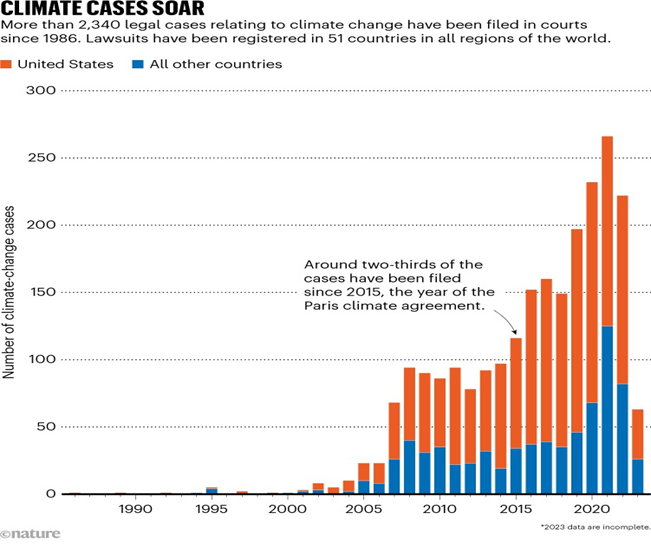
(Image Source: Carissa Wong, “Do Climate Lawsuits Lead to Action? Researchers Assess Their Impact”, Nature (16 Apr. 2024)
Analysis of Supreme Court Jurisprudence
Starting off differently each time, one sees how legal actions shaped city environments. From courtroom decisions emerged early forms of climate response long before the term became common. A key moment came through litigation led by M.C. Mehta, where clean air took center stage[26]. Instead of waiting for new laws, judges stepped in when pollution crossed danger levels. Public buses once ran on fuels that darkened skies; now many burn cleaner gas due to judicial push. Though health drove the case, the outcome cut carbon at large scale. Change did not come slowly – it arrived fast because courts ordered swift shifts. Transport systems shifted fuel types overnight, altering urban emissions sharply. This pivot marked an unplanned but effective turn toward lower-carbon cities.
Nowhere was the connection clearer than in how judges linked dirty fuel, factory output, and air quality during those rulings. Without demanding full certainty on how many people would die from car pollution, courts stepped in due to clear danger ahead[27]. Lately, environmental advocates mirror this thinking when pushing legal demands to abandon coal swiftly, favoring clean power sources instead[28]. From past decisions like M.C. Mehta emerged a key idea – courts can mandate large-scale tech changes if lives are at stake. That foundation shapes today’s lawsuits aiming to hold India to its promised climate targets. A single legal dispute over timber cutting in southern India quietly reshaped national environmental policy. Though it started locally, its influence stretched across state boundaries without warning. One judgment, issued years after proceedings began, stopped tree removal in ecologically sensitive zones outright. Instead of relying only on legislative wording, judges used common understanding to define what counts as a forest. This shift allowed broader protection beyond official classifications. Rules once limited by paperwork now respond to ecological reality. Nearly thirty years later, the rulings still guide how land is managed. A regional complaint became an enduring framework for conservation. Unexpected interpretations opened doors for stronger safeguards. Definitions evolved when courts looked past statutes toward everyday meanings.[29]
Despite its age, the Godavarman ruling still shapes how India handles forest loss. Instead of seeing trees only as wood, courts began viewing them as key players in balancing air quality. Because of this shift, any group using forest land for roads or mines now pays for what the ecosystem loses – a method called Net Present Value. These payments pile into a fund meant solely for planting new forests elsewhere.[30] Though not perfect, the system tracks environmental cost more closely than before. Thanks to these flows, India channels money toward growing back tree cover at scale. That effort lines up with promises made abroad to absorb billions of tons of carbon dioxide[31]. Over time, judges framed green cover less as property and more as part of Earth’s breathing rhythm.
III. National Green Tribunal and Climate Justice orders
Born in 2010, the National Green Tribunal reshaped how India deals with environmental conflicts. Instead of general courts, this dedicated forum includes legal professionals alongside technical specialists. Because ecological issues often involve intricate science, such expertise helps guide fair outcomes[32]. Its authority comes directly from law, especially through Section 20 of the NGT Act. Among its duties is using key ideas like sustainable growth and caution amid uncertainty. Also central is making those who harm nature bear the costs – a concept long backed by top court rulings[33]. These once-judicial notions now stand written into the tribunal’s core responsibilities. Despite criticism, the NGT took firm steps to limit emissions from aging power units. Not confined to theory, its rulings responded directly to evidence showing outdated systems pollute far more than newer ones. One key move involved curbing unchecked expansion of coal-based energy projects. Instead of accepting standard industry practices, it questioned assumptions behind routine approvals[34]. From another angle, handling waste like fly ash became a central concern after repeated environmental harm emerged nearby plant sites. Because neglected by-products seep into soil and water, consequences pile up over time[35]. With attention to detail, the body enforced rules so toxic residue does not overwhelm communities near facilities. Although biodiversity supports climate resilience, the NGT has acted firmly to defend it through landmark rulings. One ruling focused on reviving the Ganga River, following M.C. Mehta’s petition against government inaction. Another tackled damage to the Yamuna, where unchecked activities harmed its ecological balance. When major gatherings disrupted the Yamuna’s floodplain, including one led by the Art of Living group, consequences followed. Instead of overlooking harm, authorities were urged to enforce accountability under environmental norms. A sum of 5 Crore INR was levied – not as punishment alone, but to reflect responsibility for degraded ecosystems. Floodplains, after all, help refill aquifers while reducing overflow risks during extreme weather. These natural roles grow more critical as climates shift unpredictably.[36]
What stands out is how the National Green Tribunal actively safeguards Eco-Sensitive Zones and the Western Ghats, frequently halting ventures that risk breaking apart these vital carbon-storing areas. Instead of reviewing proposals one by one, it demands Cumulative Impact Assessments – this way, the full environmental weight of combined development efforts comes into view. Though small in wording, its approach shifts the entire lens[37]. Only when layered effects are visible does real accountability emerge. Starting on its own, the National Green Tribunal steps in when serious environmental harm occurs. When disasters strike – like chemical spills or forest fires – it opens cases even without someone asking. Because of this power, it keeps close watch over industries that impact nature heavily. Action begins before damage spreads further, helping prevent deeper ecological strain. What stands out is how the NGT treats Environmental Compensation as a standard response to Loss and Damage. Rather than sticking strictly to punitive measures like many legal bodies, it estimates financial needs tied to repairing nature plus forgone benefits from damaged ecosystems. Money collected frequently supports planting trees or removing pollutants – efforts that quietly strengthen local capacity to handle climate shifts[38].
In 2017, something shifted at the National Green Tribunal when a child brought attention to climate inaction[39]. Though only nine years old, Ridhima Pandey filed a petition claiming governmental efforts lacked scientific grounding. Her argument rested on the idea that nature belongs to everyone – present and unborn alike. Because of this, she said, authorities were failing their duty under what is known as the Public Trust Doctrine. Instead of waiting for adults to act, she urged the court to push for measurable steps. Among her requests: a clear accounting of carbon emissions across sectors. Also included was a call for a comprehensive strategy aimed at reversing environmental harm. While small in stature, the case carried weight far beyond its origin.[40]
IV. Challenges and Limitations of Climate Litigation in India
Figuring out who caused what lies at the heart of many climate lawsuits. Most times, courts demand clear proof that one party’s actions led directly to harm – that if the action hadn’t happened, damage wouldn’t have followed either. Yet when it comes to warming temperatures, causes are scattered. A single smokestack in Mumbai adds gases into air shared across borders, blending invisibly with pollution from countless others stretching back generations.[41] Because of this blend, tracing any storm or drought to one emitter becomes nearly impossible. Damage emerges not from isolated acts but from layers upon layers of releases piling up worldwide. When courts look for a clear proximate cause, the effort often stretches beyond reach. A lawsuit by a seaside town against a national oil firm over rising oceans may fail because one company’s emissions appear tiny within worldwide CO₂ levels[42].
Even though scientists now better connect human actions to storms or heatwaves, turning those likelihoods into legal proof still trips up judges. Civil cases demand weight of evidence; current methods struggle to meet that bar. Without new ideas like shared blame or percentage-based fault entering courtrooms, key arguments about climate harm could keep vanishing at the starting line. Even when courts allow broader access to justice, like India did with public interest litigation, hurdles around who can sue remain in environmental disputes. A person bringing a case usually needs to prove they face real or expected harm[43]. Yet climate impacts frequently unfold gradually, appearing only after many years. Such delayed consequences complicate the need for immediate, tangible damage. Long-term ecological shifts rarely fit neatly into traditional legal expectations of injury. Not every claim finds welcome in courtrooms – some get dismissed as too uncertain. Though future people matter in theory, thanks to ideas about fairness across time, bringing their interests into legal proceedings poses practical puzzles. After all, who speaks for those not yet born? When harms touch entire populations – the so-called broad complaint issue – it becomes easier for accused parties to say nobody suffers uniquely. That pressure pushes plaintiffs toward narrow angles: pollution here, damage there. Big climate narratives tend to fade when survival depends on fitting smaller molds.[44]
Scientific proof in climate cases often demands deep analysis. Because of this, judges face challenges understanding intricate modeling and emissions forecasts. Though some panels include specialists, higher courts lack such internal knowledge[45]. As a result, rulings may depend too much on outside advisors. Without built-in expertise, legal authority sometimes drifts toward these appointed figures. Decision influence moves quietly into non-judicial hands. Still, even though scientists fully agree climate change is real, predictions about particular places – say, just how far a stretch of coast in Odisha might erode by 2040 – usually come with some guesswork. Because of those unknowns, lawyers defending polluters sometimes claim the data isn’t solid enough for courts to act[46]. A rule called the Precautionary Principle aims to fill that void, yet it gets used unevenly across cases. Judges tend to hesitate, unsure when a possible environmental threat crosses into firm legal grounds requiring an immediate halt or binding order.[47]
Still, one key hurdle stands: how well courts can actually fix things. When judges rule that governments have neglected their climate responsibilities, standard penalties like fines or temporary halts rarely match the scale of planetary harm. Shutting one polluting plant might be within reach, yet demanding sweeping shifts toward clean energy crosses into territory reserved for elected leaders. The principle dividing government powers blocks deep judicial intervention. Courts hesitate before crafting detailed fixes involving money decisions or broad societal changes, aware they could appear to seize power beyond their role. As a result, rulings often stop at stating what should happen, leaving actual change untouched by enforceable steps.
V. Conclusion and Suggestions
Courts shaping fairness and long-term thinking – India’s climate cases reveal a quiet transformation in how power works. Not merely reacting to dirty air or water, judges now guide policy with an eye on future harm. Grounded in equality, their rulings make invisible harms impossible to ignore. When environmental damage strikes, it hits hardest those already struggling – this reality anchors many decisions. Rights under Article 14 and Article 21 become tools, not slogans, shielding lives from worsening extremes. Marginalized voices gain space: tribal populations, displaced families, young people facing unstable futures. Rising temperatures bring new disputes – not only about cause but burden – who pays, who moves, who decides? Adaptation emerges less as engineering challenge, more as moral reckoning within law. With each case, precedent forms slowly, built on lived experience rather than abstract theory. Legal outcomes reflect urgency, yet unfold through careful reasoning. Expect more claims linking warming trends to social fracture lines. Judgment after judgment, courts inch toward balance – between generations, regions, risk levels. This path was unforeseen decades ago; today, it feels inevitable.
Looking ahead, courts help keep environmental responsibility alive across time. Because elected officials face pressure from election timelines, their choices lean toward quick results instead of lasting impact. In contrast, judges apply ideas such as Intergenerational Equity and Public Trust to stretch legal thinking beyond the present moment. Future generations gain a voice in courtrooms where past actions shape what remains possible later. Such forward-looking rulings matter deeply in nations like India, where growth now must not block cleaner pathways ahead. A slow shift today may prevent irreversible harm tomorrow. Later on, courts may begin treating Attribution Science as standard practice. Because methods grow sharper over time, proving direct links between climate events and actors gets easier. With clearer evidence, rulings could shift from broad statements to exact orders – such as cutting emissions or building resilient systems. Specific outcomes start replacing vague acknowledgments when causality becomes harder to dispute.[48]
Looking ahead, the worldwide rise in climate-related court cases presents diverse tools – legal principles, new procedures, methods of redress – that could support reforms within India’s justice system. With India shifting its constitutional environmental focus toward deeper climate commitments, insights drawn from abroad begin to hold greater relevance.
- Cases such as Urgenda and Leghari show how powerful it can be when climate harm is seen as an attack on basic rights. India’s 2024 acknowledgment of a separate “right to be free from climate impacts” within Article 21 pushes this idea forward. Still, without more than symbolic court rulings, that right risks staying empty. From Europe’s experience emerges a different truth – rights gain strength only when tied to measurable goals. Meaningful progress demands specifics, not just statements.
- Nowhere is the link between survival and policy clearer than in India’s evolving courtroom views on environmental duty. Because judges begin tying basic rights to climate promises, elected leaders face stronger pressure to follow through. When life itself becomes the benchmark, outdated politics lose their grip on urgent reforms. Courts stepping in do not seize power – they restore balance where governments hesitate. Minimum commitments like NDCs shift from voluntary targets into measurable duties under law. This reframe does not invent new rules; it enforces existing ones more honestly. As rulings accumulate, they form a backbone for long-term planning immune to election cycles. Climate steps then stop being favors granted by generosity but conditions demanded by justice.[49]
- Beginning with existing legal principles, India’s courts have long upheld public rights over natural resources. Under rulings such as Kamal Nath, certain elements remain protected for collective benefit. Expanding this idea, the air we breathe could fall under similar protection. Seen in this light, the National Green Tribunal gains stronger footing when reviewing emissions tied to specific projects. When clearance is granted for developments that harm atmospheric integrity, questions arise about governmental accountability. Lacking sufficient reasoning, such decisions may amount to failing a core stewardship obligation. Rather than relying solely on scattered environmental statutes, this approach offers another path – one rooted in enduring responsibility toward shared ecological assets.
- One key takeaway comes from Pakistan’s Leghari case – courts can do more than rule; they can reshape how remedies work. Rather than stop at a standard directive, judges there formed a Climate Change Commission, blending expertise from public officers, specialists, and civil society groups. Such oversight structures could sharpen India’s current practice of Continuous Mandamus. A stronger path forward might involve setting up dedicated panels under the National Green Tribunal or High Courts – teams focused solely on tracking environmental compliance. These appointed Climate Monitors would check whether tree-planting drives, land recovery efforts, or pollution controls deliver real results. Progress often stalls after judgments, as earlier sections showed; ongoing supervision helps close that gap. With steady follow-up, courts shift from settling disputes to nudging systems toward lasting change.
- One key takeaway from global legal practices lies in how attribution science shapes outcomes. Instead of rejecting complex evidence, courts in India should embrace meteorological findings that tie emissions to specific weather impacts. This shift demands greater understanding of technical material among judges. Although the National Green Tribunal includes specialists, high courts – frequent venues for constitutional environmental disputes – lack such support. Without access to up-to-date climate analysis, rulings risk falling behind current knowledge.[50] A dedicated scientific advisory body for superior courts might close this gap. Such a unit would ground decisions in verified data, making it harder for causality arguments to block progress. Over time, stronger scientific integration could transform how rights linked to environment are enforced. Not every court needs a climatologist on bench – but pathways to expertise matter. When facts align with law, delays shrink. What seems distant today may soon become standard practice elsewhere tomorrow.
- One way forward comes from Australia – climate factors now shape decisions on major projects through merits review. Tick-box criticism hits Indian systems such as EIA hard; they lack real teeth. A stronger path appears when Climate Impact Assessment becomes law-bound, required for each big development plan. Without waiting for a national climate law, the NGT holds tools already: powers under the EPA allow it to demand proof of alignment with Net Zero goals. When approvals hinge first on climate safety, growth avoids undermining future stability.
[1] Ranveer Singh Rathore, ‘Climate Litigation in India: The Rise of Environmental Justice and Green Court Orders’ The Lawscape (last visited May 26, 2026).
[2] Eeshan Chaturvedi, “Climate Change Litigation: Indian Perspective”, 22 German Law Journal 1459–1470 (2021).
[3] Vidya Ann Jacob, ‘Climate Litigation in India: An Overview’ ILI Law Review 73 (2021).
[4] Dr Maroof Bashir, Ashlesha G. Mulay & Smruti Kamble, “Climate Change Litigation in India: Emerging Trends and Landmark Cases” 14(3) International Journal of Creative Research Thoughts a960–a979 (2026).
[5] Intergovernmental Panel on Climate Change (IPCC), Climate Change 2021: The Physical Science Basis. Contribution of Working Group I to the Sixth Assessment Report of the IPCC 45 (Cambridge University Press, Cambridge, 2021).
[6] Grantham Research Institute on Climate Change and the Environment, ‘What is Climate Change Litigation?’ (London School of Economics and Political Science, 9 August 2024) https://www.lse.ac.uk/granthaminstitute/explainers/what-is-climate-change-litigation/ accessed 26 May 2026.
[7] Precious Okedele, Reginald Aziza, Portia Oduro & Akinwale Ishola, ‘Climate Change Litigation as a Tool for Global Environmental Policy Reform: A Comparative Study of International Case Law’ 8(2) Open Access Research Journal of Multidisciplinary Studies 104–115 (2024).
[8] Navroz K. Dubash (ed.), India in a Warming World: Integrating Climate Change and Development 145 (Oxford University Press, New Delhi, 2019).
[9] Hardik Khandelwal, “PILs Turned Citizens Into Guardians of India’s Environment”: Justice N Kotiswar Singh, LAWCHAKRA (Nov. 18, 2025), https://lawchakra.in/legal-updates/pils-citizens-india-justice-n-kotiswar/.
[10] Aruno Singh & Rashika Sharma, ‘The Role of Public Interest Litigation (PIL) in Environmental Protection in India: From Oleum Gas Leak to Climate Litigation’ 11 Vidhyayana 596–622 (2025).
[11] P.N. Bhagwati, “Judicial Activism and Public Interest Litigation”, 23 Columbia Journal of Transnational Law 561 (1985).
[12] Climate Change Litigation in India Rising PIL Trends, LawCurb (last visited May 26, 2026).
[13] Aman Kumar, ‘Constitutional Green Justice: Expanding Article 21 for a Sustainable Future’ Jus Corpus (4 Nov. 2025) accessed 26 May 2026.
[14] Fundamental Rights and the Environment: How Article 21 Evolved to Protect Nature, EVS Institute (15 Oct. 2025) https://evs.institute/environmental-legislations/fundamental-rights-environment-article-21/ accessed 26 May 2026.
[15] Hitaishi Subhash Sawant, ‘Beyond the Procedure: The Birth of Article 21 and its Evolution’ 8(2) Indian Journal of Law and Legal Research 6287–6306 (2026).
[16] Rural Litigation and Entitlement Kendra v. State of U.P., 1985 CR (3) 169.
[17] James R. May and Erin Daly, Global Environmental Constitutionalism (Cambridge University Press, Cambridge, 2014).
[18] Subhash Kumar v. State of Bihar, AIR 1991 SC 420.
[19] Virender Gaur v. State of Haryana (1994), (1995) 2 SCC 577.
[20] Arpitha Kodiveri, ‘The Genre-Bending of Climate Litigation in India’ (Verfassungsblog, 7 May 2024) https://verfassungsblog.de/the-genre-bending-of-climate-litigation-in-india/ accessed 26 May 2026.
[21] Climate Change Litigation in India: An Emerging Frontier in Environmental Law (2026), Vydehi Institute of Law, available at: https://vil.ac.in/climate-change-litigation-in-india-2026/ (last visited May 26, 2026).
[22] Aakriti Gupta, ‘Environmental Jurisprudence in India: From the Bhopal Gas Tragedy to Recent Climate Change Litigations’ Vintage Legal (8 January 2025) https://www.vintagelegalvl.com/post/environmental-jurisprudence-in-india-from-the-bhopal-gas-tragedy-to-recent-climate-change-litigatio accessed 26 May 2026.
[23] Michael Burger & Justin Gundlach, The Status of Climate Change Litigation: A Global Review (Sabin Center for Climate Change Law, Columbia Law School & UN Environment, May 2017), available at: https://scholarship.law.columbia.edu/sabin_climate_change/98 (last visited May 26, 2026).
[24] Bibi v. State of Tamil Nadu, 2022 SCC OnLine Mad 2383.
[25] Raghuveer Singh, “Judicial Review of Environmental Impact Assessment”, 4 NALSAR Law Review 90 (2009).
[26] Joana Setzer & Lisa Vanhala, ‘Climate Change Litigation: A Review of Research on Courts and Litigants in Climate Governance’ 10(3) Wiley Interdisciplinary Reviews: Climate Change e580 (2019).
[27] Shibani Ghosh, ‘Litigating Climate Claims in India’ 114 AJIL Unbound 45–50 (2020).
[28] Sansa Legal, ‘Climate Change Litigation in India: Emerging Legal Precedents’ (Sansa Legal, 21 February 2025) https://www.sansalegal.com/post/climate-change-litigation-in-india-emerging-legal-precedents-2-minutes-read accessed 26 May 2026.
[29] Sanjay Upadhyay and Videh Upadhyay, Handbook on Environmental Law in India (LexisNexis, New Delhi, 2002).
[30] Court on its Own Motion v. State of Himachal Pradesh, 2014 SCC OnLine NGT 1.
[31] Maria José Azar-Baud, ‘Environmental Proceedings from a Comparative Perspective When Substance Drives Proceedings’ in Burkhard Hess, Margaret Woo, Loïc Cadiet, Séverine Menétrey and Enrique Vallines García (eds), Comparative Procedural Law and Justice (Part XII Chapter 5, CPLJ 2025) https://www.cplj.org/publications/12-5-environmental-proceedings-from-a-comparative-perspective-when-substance-drives-proceedings accessed 26 May 2026.
[32] Climate Change Litigation in India: Navigating Legal Responses to Environmental Challenges, Legal Service India (last visited May 26, 2026).
[33] Gitanjali Gill, ‘Environmental Justice in India: The National Green Tribunal and Expert Members’ 5 Transnational Environmental Law 1–31 (2015).
[34] Centre for Science and Environment, ‘National Green Tribunal: A New Beginning for Environmental Cases’ (CSE India, 2010) https://www.cseindia.org/national-green-tribunal–a-new-beginning-for-environmental-cases-2900 accessed 26 May 2026.
[35] “National Green Tribunal (NGT)”, Understand UPSC (last visited May 26, 2026).
[36] Shubhankar Dam and Vivek Tewary, “Polluting Environment, Polluting Constitution: Is a ‘Pollution-Free Environment’ a Fundamental Right in India?”, 17 Leiden Journal of International Law 175 (2005).
[37] “The Role of the National Green Tribunal (NGT): Is it Effective?”, Vintage Legal (last visited May 26, 2026).
[38] Shirley Kiran Kalapala, Dr. Mamata Mohanty & Dr. Sneha Tiwari, “The Role of the National Green Tribunal (NGT) in Environmental Protection” 11(23s) International Journal of Environmental Sciences 2321 (2025).
[39] S. Shubhang, ‘National Green Tribunal Act, 2010: A Critical Appraisal’ 4(1) Research Journal of Humanities and Social Sciences 101–105 (2013).
[40] Bharat H. Desai, “Enforcement of the Right to Environment”, 33 Environmental Policy and Law 30 (2003).
[41] Indian Council for Enviro-Legal Action v. Union of India, (2011) 8 SCC 161.
[42] Arpitha Kodiveri, ‘The Promises and Challenges of Climate Change Litigation in India’ (Open Global Rights, 28 June 2020) <https://www.openglobalrights.org/promises-and-challenges-of-climate-change-litigation-in-india/> accessed 26 May 2026.
[43] Shuma Talukdar, ‘Challenges in Climate Litigation in India: Analysing the Legal Framework and Its Effects on Climate Action’ in Climate Litigation and Environmental Justice (Springer Nature 2026) DOI: 10.1007/978-3-032-05530-9_13.
[44] Upendra Baxi, “The Heritage of Judicial Activism in India”, 4 NALSAR Law Review 1 (2009).
[45] A. Kodiveri, “Climate Change Litigation in India: Its Potential and Challenges” in C. Rodríguez-Garavito (ed.), Litigating the Climate Emergency: How Human Rights, Courts, and Legal Mobilization Can Bolster Climate Action 364–375 (Cambridge University Press 2022).
[46] Battling the Climate Crisis in Court: The Mutual Relationship Between Climate Litigation and India’s Environmental Future, NLIU Law Review (last visited May 26, 2026).
[47] Association for Environmental Protection v. State of Kerala, (2013) 7 SCC 226.
[48] Navroz K. Dubash and Ankit Bhardwaj, “State Capacity and the Governance of Climate Change in India”, 53 Economic and Political Weekly 54 (2018).
[49] Advocate Padam Bahadur Shrestha v. Government of Nepal, (2018) Writ No. 074-WO-0283.
[50] Mary Christina Wood, Nature’s Trust: Environmental Law for a New Ecological Age (Cambridge University Press, Cambridge, 2014).
[1] Assistant Professor, University School of Law, Rayat Bahra University, Mohali, Punjab, India.
[2] Student of LLM, University School of Law, Rayat Bahra University, Mohali, Punjab, India.