
Apoorvi Bajpai
LLM IP
Amity University, Noida
Abstract
Atmospheric manipulation technologies, including weather modification, cloud seeding, geoengineering, and climate intervention systems, have emerged as significant scientific innovations aimed at addressing environmental and climatic challenges. The rapid advancement of such technologies has generated complex legal and intellectual property concerns, particularly regarding their patentability under existing patent regimes. This research paper critically examines the conceptual and scientific dimensions of atmospheric manipulation technologies and analyzes their patentability within the framework of Indian patent law.
The study explores the applicability of the patentability requirements under the Patents Act, 1970, including novelty, inventive step, industrial applicability, and non-obviousness, in relation to atmospheric technologies. It further evaluates the limitations imposed by Section 3 of the Patents Act, especially concerning discoveries, scientific principles, methods contrary to public order, and environmental implications. The paper also examines international patent practices and comparative approaches adopted in jurisdictions such as the United States and the European Union regarding climate engineering and weather modification technologies.
Through a doctrinal and analytical research methodology, the study investigates whether atmospheric manipulation technologies can be adequately protected under the existing Indian intellectual property framework while balancing environmental ethics, public interest, and sustainable development concerns. The research identifies significant legal ambiguities relating to ownership, regulation, environmental risk, and monopolization of climate-related technologies.
The paper concludes that although atmospheric manipulation technologies possess considerable scientific and commercial potential, the Indian patent regime requires clearer regulatory guidelines and specialized policy mechanisms to address the unique environmental and ethical dimensions associated with such innovations. The study emphasizes the need for a balanced approach that promotes technological innovation while safeguarding ecological sustainability and public welfare.
Keywords: Atmospheric Manipulation; Patentability; Indian Patent Law; Weather Modification; Climate Technologies; Patents Act, 1970; Intellectual Property Rights; Environmental Regulation.
2.1 Meaning and Evolution of Weather Modification
In the year 2000, scientists from the General Electric Company named Irving Langmuir and Vincent Schaefer altered clouds by “seeding” them with dry ice pellets so that they would behave differently. Not too much longer after that, a colleague named Bernard Vonnegut demonstrated that the same effect could be achieved by inhaling the smoke of silver iodide crystals. Cloud seeding was the beginning of the contemporary American history of weather and climate change. This event marked the beginning of that history. These American scientists on November 13, 1946, had verified experimentally the theory advanced in 1933 by the Swedish meteorologist, Tor Bergeron, and the German physicist, Walter Findeisen, that clouds would precipitate if they contained the right mixture of ice crystals and supercooled water drops. The work of August Veraart, a Dutch scientist, was the work that came before the Bergeron-Findeisen theory. The enthusiastic comments that Veraart made about his experiments with dry ice and supercooled water-ice in Holland in 1930 were not well accepted by the scientific community in Holland, and as a result, they were not given any serious consideration anywhere else.
The alteration of weather and climate, often known as “rainmaking” (the more common and also more confined term), is not something that is new to our era or to our country. A great number of traditional groups, especially the American Indians, have engaged in some form of religious or ritualistic rainmaking. Throughout history, people have performed a wide range of ceremonies and rituals, including dousing holy men with water and burying children up to their necks in the dirt. This was done in the belief that the gods would be compassionate and shed tears from the heavens. In addition to bringing about a certain kind of weather that is ideal, the purpose of these ceremonies is to reinforce the religious beliefs and viewpoints of the tribal people, which are essential to the preservation of social cohesiveness. Numerous techniques have been proposed and attempted to induce or assist rainfall throughout the course of history, both in the past and in the present. Before the turn of the 20th century, the United States Government granted two patents for rainmaking techniques. These patents were based, respectively, on the production of carbon dioxide through the release of “liquified carbonic acid gas” and on the concussion that occurred as a result of the explosion of explosives. The patent, which has been expired for a very long time, was based on the creation of carbon dioxide in the form of dry ice. It is interesting to note that the cloud seeders of today were foreseen by the patent. The Federal Government provided financial assistance to meteorologists working in the War Department and the Navy Department who were doing groundbreaking research in the field and in the laboratory on the widely held belief that the explosion of explosives could be the source of precipitation.
Even problems on a social, political, and legal level over weather and climate change are not new. The employment of a rainmaker in San Diego in 1916, which resulted in claims of loss of life and property damage totalling one million dollars, predicted by fifty years the legal and legislative action that is currently being taken by the state and local governments. The examination of fog particles that Langmuir and Schaefer conducted during World War II culminated in the showing in 1946 that clouds could be altered and rain could be produced via the application of scientific procedures. Between the years 1947 and 1952, the United States Armed Forces supported a comprehensive theoretical, laboratory, and field effort in cloud modification that was known as Project Cirrus. This program was based on the military possibilities that this discovery presented. The Cloud Physics Project, which was conducted by the United States Weather Bureau, the Air Force, and the National Advisory Committee for Aeronautics, looked at the implications of cloud physics for both civilians and the military between the years 1948 and 1951. After the conclusion of Project Cirrus in 1952, the Department of Defence initiated a five-year Artificial Cloud Nucleation Project. This project was immediately implemented by the military forces.
Regardless of whether the multi-million dollar commercial rainmaking activities that occurred in the late 1940s and early 1950s were the result of the obvious interest of the Federal Government in weather and climate modification research or the coincidental severe drought conditions that occurred in certain regions of the country, the fact remains that relatively large operations became a reality. Between the years 1951 and 1953, during the Congressional Hearings that led up to the establishment of the Advisory Committee on Weather Control, it was revealed that during the height of cloud seeding activities, water users, particularly in the West, were spending between $3 and $5 million annually on cloud seeding for commercial purposes. Additionally, it was revealed that approximately 10% of the land area of the United States had become the target of cloud seeding attempts. Rekindling the scientific interest in hail suppression, which had been conducted in Alpine Europe since the middle of the 1930s, the weather modification events that occurred in the United States in the late 1940s and early 1950s inspired cloud seeding operations in Australia, France, and South Africa to boost precipitation. These programs were implemented in order to promote more precipitation. In the late 1940s, there were twelve countries that were experimenting with cloud seeding. By 1951, that number had more than doubled, and there were approximately thirty countries representing every continent. In the meantime, the drought that was prevalent in many regions of the country, the assertions made by some of the rainmakers, and the criticism from certain segments of the scientific community have led to the establishment of an Advisory Committee on Weather Control by the Congress. The purpose of this committee is to investigate and evaluate both public and private experiments in weather modification. The Advisory Committee on Weather Control discovered, among other things, on the basis of statistical evaluations, that cloud seeding in the mountainous regions of the western United States of America caused storms to occur during the cooler and more humid winter and spring months. This resulted in an average increase in precipitation of 10 to 15 percent from seeded storms, and there was a satisfactory degree of probability that the increase was not the result of natural variations in the amount The Committee came to the conclusion, among other things, that seeding clouds from the ground using silver iodide generators is a valid approach for seeding clouds. This conclusion was reached on the basis of these physical evaluations.
There are around 7.2 million dollars in total annual spending for all of the several federal government programs that are involved in weather modification research and development during the fiscal year 1966. There were 59 cloud seeding projects carried out by 15 commercial operators in 26 different states during the year that ended on June 30, 1965. These projects were carried out by the end of the year. At this time, there have been reports of research activity coming from fifteen different countries. In November 1963, in response to increased concern over the potentialities for manmade changes of weather and climate and the interest in undertaking large scale weather modification activities, the Committee on Atmospheric Sciences of the National Academy of Sciences (NAS) appointed a Panel on Weather and Climate Modification “to undertake a deliberate and thoughtful review of the present status and activities in this field, and of its potential and limitations for the future.”[1] The appointment of the Special Commission on Weather Modification was announced by the Director of the National Science Foundation on June 16, 1964. This appointment was authorised by the National Science Board in its 89th Meeting, which took place on October 17-18, 1963.
The Commission was assigned to:
- fulfil the need of the National Science Foundation for a review of the state of knowledge on weather and climate modification, make recommendations concerning future policies and programs and examine the adequacy of the Foundation’s program; and
- respond to the request of the Inter-departmental Committee for Atmospheric Sciences of the Federal Council for Science and Technology of August 19, 1963, to prepare an analysis of the modification and control of the weather for useful purposes other than military. Not only did the Commission have to take into account the scientific aspects, but they also had to take into account the legal, social, and political issues that were present in the respective subject.
Each of the seven sub-groups that were activated by the Commission was led by one or more members of the Commission. This was done in response to the broad categories of issues that were given to the Commission by the National Science Foundation. These subgroups have conducted research on several issues, including those that pertain to the physical, biological, statistical, social, international, legal, and legislative aspects, as well as administration and funding. The primary method by which the physical science issues have been investigated is through collaborative and ongoing consultation and cooperation with the Panel on Weather and Climate Modification of the National Academy of Sciences. Under the auspices of grants or contracts from the National Science Foundation, a significant portion of the preparatory work that was involved in the treatment of the various parts of the subject was carried out.
2.2 Types of Atmospheric Manipulation Technologies
2.2.1 Cloud Seeding
Cloud droplets develop when atmospheric water vapour condenses on minute particles in the atmosphere known as cloud condensation nuclei (CCN). A cloud generally consists of minuscule water spheres with diameters varying from several micrometres to several tens of micrometres. The concentration of cloud droplets per cubic centimetre varies from under 100 to over 1,000, with an approximate average of 200 droplets per cubic centimetre. Clouds above the ocean generally contain a lower density of cloud droplets per cubic centimetre compared to those over land, due to the reduced presence of cloud condensation nuclei in marine air.
A significant attribute of a cloud is its temperature. When the temperature exceeds 0° C, the cloud is classified as warm. Clouds frequently form at elevations where temperatures are sub-zero, however the droplets remain unfrozen due to the water’s cleanliness. These clouds are referred to as supercooled. Supercooling to temperatures of −10° C or even −20° C in the atmosphere is commonplace. A decrease in temperature increases the probability that droplets may encounter ice nuclei, resulting in their freezing. At temperatures below around −40° C, nearly all clouds consist of ice crystals.
Numerous all-liquid clouds, regardless of being warm or supercooled, exhibit stability as the droplet sizes are confined to several tens of micrometres, allowing the clouds to persist for an extended duration without producing precipitation.
Occasionally, nature lacks sufficient ice nuclei, leading to the prolonged existence of supercooled clouds for several hours. In such instances, the introduction of ice nuclei might destabilise the cloud by facilitating the formation of ice crystals, which may subsequently develop and lead to precipitation. The process of introducing a chemical into clouds to alter their properties is referred to as cloud seeding. Warm clouds (over 0° C) have been artificially stimulated using substances such as sodium chloride or calcium chloride particles, or through a water spray. The aim of these techniques is to generate large cloud droplets that will increase in size through coalescence, descend, and eliminate smaller cloud droplets. Fog at airports has been seeded to diminish cloud density and enhance visibility and ceiling conditions. Warm convective clouds have undergone seeding to enhance precipitation.
Aircraft have been utilised to disseminate a water spray or salt particles. In several instances, saltwater aerosols have been released. Regrettably, such treatments are often deleterious to aircraft surfaces and require careful handling. In certain programs, powdered sodium chloride particles have been aerosolised from the ground. The majority of cloud-modification efforts have focused on supercooled clouds and have utilised ice nuclei for seeding. The initial ingredient identified as effective for cloud seeding was dry ice. The temperature is so low (about −78° C) that it induces the spontaneous formation of ice crystals from water vapour. It is estimated that one gram of dry ice will generate a minimum of 3 × 10 ice crystals. The predominant method for seeding with dry ice involves flying above a cloud and dispersing crushed pellets, ranging from less than one millimetre to a few millimetres in diameter, along the flight route. A standard seeding rate may be several kg of dry ice every kilometre of flight.
Dry ice is no longer commonly utilised as a cloud-seeding agent due to the necessity of its delivery to the supercooled areas of the cloud and the limitation that, once a pellet of dry ice has sublimated, it can no longer influence the cloud. Supercooled clouds are predominantly seeded with minute particles of silver iodide. Numerous methodologies exist for seeding with silver iodide. All of them generate substantial quantities of minute particles with diameters ranging from approximately 0.01 to 0.1 micrometre. A standard approach involves dissolving silver iodide in a sodium iodide solution within acetone. The content of silver iodide may vary from 1 to 10 percent. When the solution is combusted in an adequately ventilated room at around 1,100° C, a substantial quantity of ice nuclei is generated. The concentration escalates swiftly as the temperature diminishes. At −10° C, a standard quantity is 10 ice nuclei per gram of silver iodide. Ultraviolet light exposure rapidly deactivates silver iodide nuclei. Nuclear concentrations may diminish by approximately a factor of 10 for every hour of exposure.
In the United States, France, Switzerland, and Argentina, a significant amount of silver iodide seeding has been conducted using ground generators. In such instances, air currents are anticipated to convey the nuclei into the supercooled regions of the cloud. Researchers in the United States, Australia, Israel, and other nations have utilised aircraft for the dissemination of silver iodide particles. Primarily, silver iodide in acetone has been ignited in generators affixed to the wings of one or more aircraft. Pyrotechnical instruments have been utilised for this purpose in some tests. A solid mixture of silver iodide and an inflammable substance gets ignited when released from above into clouds.
Soviet experimenters utilised ground-launched rockets. This approach was initially utilised in Italy, but the Soviets enhanced it by utilising a more advanced rocket that allowed the pyrotechnic mixture to be fired at any point throughout its trajectory. In the Soviet studies, extensive ice-nuclei seeding was conducted using 70-millimeter artillery guns that discharged projectiles containing 100 to 200 kilos of lead iodide or silver iodide. At a specified location, the projectile detonated and scattered the ice nuclei.
The majority of cloud-modification efforts have focused on altering the dimensions of cloud particles or the buoyancy of the surrounding air. A lot of scientists have focused on devising methods to alter the electrical composition of clouds. A practical objective has been the diminution of forest fires sparked by lightning. Small clouds have been electrically altered by discharging substantial amounts of ions from an elongated wire positioned near the ground. Efforts to modify the electrical characteristics of substantial thunderstorms have included seeding with ice nuclei and, in a separate series of studies, with several small metal strips. The objective has been to avert the concentration of electrical charge in clouds to the extent that a lightning strike would transpire.
Fog dissipation
Both the ceiling, which is the height of the cloud base above the ground, and visibility must be higher than the minimum thresholds that have been defined in order for aeroplanes to be able to take off and land. It is anticipated that fog-related airport closures in the United States will result in airport closures costing airlines millions of dollars annually. In the course of World War II, when Allied aircraft took off from fog-covered England, the considerable impact that low ceilings and visibility had on military aircraft operations was brought into stark relief. In the latter half of the 1930s, there was an attempt made to disperse fogs by adding salt particles, more especially calcium chloride. However, despite the fact that this technique appeared to be impossible, substantial progress was made. In the middle of the 1940s, when airport runways were being cleared, significant amounts of heat were utilised. The fog investigation dispersal operations, also known as FIDO, were carried out with the assistance of kerosene burners that were placed along the runways. As a result of the heat that they released, the relative humidity of the air was reduced, which led to the evaporation of droplets and a significant improvement in ceiling and visibility, which made it easier for aeroplanes to land and take off. Ice nuclei have been responsible for the dissipation of supercooled fogs for a considerable amount of time. There are tables that have been produced that outline the quantities of dry ice that are to be deployed, and these numbers are reliant upon variables such as the temperature, the cloud density, and the wind speed. A typical seeding rate is around two kg for every kilometre spent in the air. In order to facilitate the distribution of dry ice pellets or flakes from an aircraft or from the ground, specialised equipment has been developed. These methods are effective in a cloud chamber, which allows for the creation of stationary sound waves; however, there is little evidence to suggest that viable sound sources can appreciably modify the properties of fog when it is present in the open sky.
Precipitation modification
Following Schaefer’s demonstration that dry ice seeding might alter supercooled stratus clouds, numerous initiatives were launched to enhance precipitation in economically significant quantities. The initial cloud-seeding experiments revealed that, during the dissipation of stratiform clouds, minor quantities of snow precipitated that would not have occurred in the absence of seeding. Some meteorologists posited that seeding dense clouds might significantly enhance precipitation in the form of rain or snow. Regrettably, in the context of organising a scientific experiment to evaluate this theory, a thicker cloud correlates with an increased likelihood of natural precipitation. Cloud thickness alone does not provide a definitive indication of the amount of precipitation, whether rain or snow. Additional elements, including the intensity and duration of the cloud updraft, cloud-top temperature, horizontal dimensions of the cloud, and its microphysical characteristics, affect the quantity of precipitation.
The intricate characteristics of clouds have thus far impeded efforts to create quantitative rainfall forecasts with adequate precision for assessing a cloud-seeding initiative. Moreover, it is widely recognised that precipitation exhibits significant variability in both spatial and temporal dimensions. Consequently, it is unfeasible, based on a scientific theory, to adequately address the inquiry, “What quantity of rain or snow would have occurred in the absence of cloud seeding?” The most credible information regarding the impacts of cloud seeding has originated from programs that utilised statistical methodologies to create experiments and evaluate hypotheses related to the efficacy of specific cloud-seeding initiatives. Numerous experimental designs and evaluation methods have been employed since the late 1940s. Numerous disputes have arisen among scientists and statisticians on the interpretation of previously executed programs.
A critical inquiry has emerged regarding the scientific merit of precipitation-augmentation initiatives undertaken by private or commercial entities. Such activities have typically relied on the premise that seeding would enhance precipitation. Their execution has not been as experiments aimed at determining if such would be the outcome. Some leading statisticians assert that the absence of intentional incorporation of “randomised” or other control measures to mitigate operator bias renders the data produced unsuitable for evaluating the effectiveness of cloud seeding. Consequently, in 1957, the U.S.
Advisory Committee on Weather Control’s hopeful results regarding the efficacy of cloud seeding were dismissed by several statisticians. The committee’s final report determined that silver iodide seeding augmented precipitation from winter supercooled clouds over the mountainous western United States by approximately 10 to 15 percent. In 1966, a specialised panel of the National Academy of Sciences, utilising data primarily sourced from private or commercial entities, reached a nearly identical finding. Since the late 1990s, silver iodide is routinely used to seed winter supercooled clouds over the mountainous western United States in order to increase the snowpack.
Recent evidence suggests that ice-nuclei seeding can enhance precipitation from specific supercooled clouds by several tens of percent. Under different conditions, the seeding may result in reductions of about same size. In some meteorological conditions, seeding proves unsuccessful. With few exceptions, it remains impossible to delineate the conditions under which good or negative impacts are anticipated to manifest. In specific supercooled clouds, the temperature at the cloud’s upper boundary is a significant, but not exclusive, predictor of the probable impacts of ice-nuclei seeding.
Since the late 1960s, there has been a growing endeavour to create mathematical models of clouds and cloud systems. Upon the establishment of an accurate model, it becomes feasible to compute the anticipated outcomes of ice-nuclei seeding utilising a computer. This methodology was utilised by Joanne Simpson of the U.S. Environmental Science Services Administration and colleagues to examine the impact of substantial quantities of silver iodide on cumulonimbus clouds. She discovered that the influence of ice nuclei on substantial convective clouds closely aligned with theoretical predictions.
Particular clouds were induced to develop and generate increased precipitation compared to their unseeded state. A significant yet unanswered inquiry pertains to the impact of cloud seeding on precipitation downstream from the designated location. Predominantly, studies indicate surpluses of precipitation; yet, there remains the potential for reductions, not only in downwind areas but in all other directions as well. Numerous experiments have been conducted to induce precipitation from warm cumulus clouds using the seeding of sodium chloride particles. Experiments in India and several other nations reportedly succeeded in augmenting rainfall.
Solar Radiation Management (SRM)
The term “Solar Radiation Modification” (SRM) refers to acts that are deliberately carried out on a broad scale with the intention of lowering the average surface temperatures of the planet by increasing the amount of sunlight that is reflected away from the planet. The use of aerosols, which are small particles, or other materials to improve the reflectivity of the atmosphere, clouds, or the surface of the earth is one of the proposed strategies for atmospheric radiation management (SRM). The use of these techniques has the potential to reduce surface temperatures more rapidly than the use of carbon dioxide removal (CDR) techniques, hence mitigating certain dangers associated with climate change. However, these techniques also carry additional concerns that are not yet fully known.
Carbon dioxide (CO2) emissions, which are a long-lived greenhouse gas (GHG), have been the single most significant contributor to climate change induced by human activity since the beginning of the industrial revolution. It is necessary to make significant reductions in emissions and atmospheric concentrations of carbon dioxide and other greenhouse gases in order to protect the climate and oceans of the Earth over the long run. In the context of climate change mitigation measures, which include decarbonisation and reductions in greenhouse gas emissions, SRM is not considered to be an alternative. As a reaction to rising worries that the rate of CO2 emissions reductions and the development of CDR technology is not adequate to avoid severe repercussions of climate change in the coming decades, research on SRM is currently being carried out. The foundation for decisions about the deployment of SRM is provided by research into the viability and effectiveness of SRM procedures, as well as potential unintended consequences.
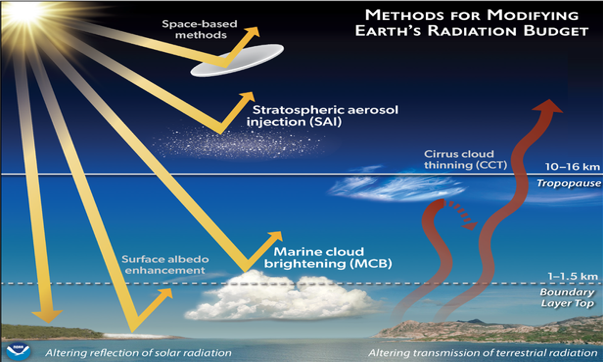
The scientific community is currently engaged in extensive research efforts with the goal of gaining a full understanding of the feasibility, dangers, advantages, and negative repercussions of potential SRM solutions to reduce surface temperatures. A wide variety of hypothetical future scenarios that include emissions reductions, carbon dioxide reduction, and SRM to varied degrees and over varying periods are the focus of research on SRM. These scenarios are developed and studied. One such scenario, which is widely referred to as “peak-shaving,” would involve the use of SRM as a temporary strategy in conjunction with significant reductions in greenhouse gas emissions and aggressive carbon dioxide reductions in order to stabilise world temperatures and offset some of the most detrimental effects of climate change.
It is possible that deployments of SRM that are large enough to temporarily counterbalance the effects of climate change could entail significant hazards as well as repercussions that were not planned or anticipated. Complex chemical, radiative, and dynamical interactions are the driving force behind the side effects of Sustainable Resource Management (SRM). These interactions include changes to the hydrologic cycle and clouds, as well as effects on ecosystems, agricultural production, and the carbon cycle. Additional consequences on the protective stratospheric ozone layer can be attributed to the presence of SAI, while adjustments to the El Niño Southern Oscillation can be attributed to the presence of MCB. Using risk against risk analysis, it is necessary to examine and assess the potential dangers and advantages that SRM may have for human health and well-being as well as for ecosystems. This evaluation and assessment should be done in comparison to the risks and benefits that are associated with probable trajectories of ongoing climate change that do not involve SRM. The current understanding of hazards and benefits is restricted due to the uncertainties that exist in the modelling tools and observations that are utilised to investigate the effects of SRM.
As a result of the fact that the warming caused by greenhouse gases and the cooling caused by SRM are two distinct physical mechanisms, SRM would not be able to simply correct the warming caused by GHG and would not be able to reverse all climatic changes everywhere. As a matter of fact, the consequences of climate change on regional weather patterns will not be completely reduced by SRM strategies. When compared to a climate that does not include SRM, certain locations may experience conditions that are cooler or wetter, while others may experience conditions that are warmer or drier. The acidification of the oceans will also continue unabated if greenhouse gas emissions are allowed to continue.
It is important to note that the manner in which and the timing of the deployment of SRM are two factors that determine the success of SRM in mitigating the effects of global warming as well as the potential unexpected consequences. According to findings from recent research on SRM, it is possible to mitigate some of the adverse effects by developing an appropriate injection strategy (i.e., the location, amount, and timing of the injection). A significant amount of modelling work is currently being done in order to gain better understanding of the processes and implications of both SAI and MCB. Over the course of these efforts, the fundamental effectiveness of SRM in lowering the temperatures of the Earth’s surface has been shown. In addition, a number of gaps and ambiguities in our current understanding have been identified, as well as the possibility of unforeseen consequences.
There are a number of processes that are among the most unpredictable components of the climate system. These processes include those that influence the development of clouds and aerosols, which are among the most relevant processes for understanding SRM techniques. As a result of variances in the way that aerosol processes, atmospheric transport and mixing, and physics are represented, climate models differ in their ability to simulate large-scale aerosol climate effects, including the effects on surface temperatures. Regarding the changes that are linked with SRM, there are still a great deal of questions regarding the changes in large-scale circulation, regional climate, air quality, and weather. Due to the fact that research on low-level clouds has also revealed complex interactions with aerosols, it is difficult to anticipate the overall climate effect that would result from injecting particles into the lower atmosphere for MCB. For a better understanding of these fundamental processes, it is necessary to conduct more extensive studies of the atmosphere and to develop new modelling techniques.
Carbon Dioxide Removal (CDR) Techniques]
Geoengineering methods seek to augment or expedite the process of natural chemical weathering by increasing the exposure of rock to weathering. A method to achieve this involves incorporating a silicate mineral, such as olivine, into the soil to facilitate weathering. Although the method appears straightforward, it may prove costly and energy-demanding, necessitating operation on a scale comparable to existing energy systems that contribute to CO2 emissions. Substantial volumes of rocks must be extracted, pulverised, transported, and subsequently distributed across fields. It is projected that an annual volume of around 7 km³ of ground silicate minerals, which react with CO2, would sequester as much CO2 as our present emissions, effectively doubling the existing rate of coal mining.
Enhanced chemical weathering may also occur by simulating natural weathering processes in an industrial environment, such as extracting CO2 from a fossil fuel combustion power plant and reacting it with pulverised silicate rock. An alternative method involves heating limestone (the carbonate rock composed of CaCO3) to the temperature at which it emits CO2, capturing this CO2, and subsequently reacting it to produce lime (Ca(OH)2). In both methodologies, the reaction’s result would be introduced into the ocean. Introducing lime to the ocean would elevate its alkalinity, hence enhancing the absorption of CO2 from the atmosphere.Four A third method involves grinding and depositing powdered calcium carbonate straight into the ocean, thereby decreasing ocean acidity and augmenting CO2 absorption from the atmosphere.
The process would be exceedingly gradual; introducing 4 billion tonnes of calcium carbonate to the ocean annually would require 200 years to achieve an atmospheric CO2 absorption rate of approximately 1 Gt per year.Five In 2014, global fossil fuel combustion emitted around 32 gigatons of CO2 into the atmosphere. What are the ecological implications of augmented chemical weathering? Land degradation and pollution resulting from extensive mineral exploitation and transportation initiatives are significant issues. Implementing enhanced weathering in an industrial context necessitates energy, which would result in additional CO2 emissions if derived from fossil fuel sources. The chemical, biological, and ecological ramifications of discharging minerals into the ocean or altering the ocean’s alkalinity remain poorly comprehended.
Researchers have suggested augmenting this process by “fertilising” the ocean: introducing nitrogen, phosphate, or iron into seawater to stimulate phytoplankton proliferation at the surface. Iron fertilisation has been the favoured method as phytoplankton generate significantly more carbon per mole of iron compared to per mole of nitrogen or phosphate. Researchers have identified the Southern Ocean as a potential site for iron fertilisation. Phytoplankton proliferation is presently constrained by a deficiency of iron in surface waters; nevertheless, the water is abundant in nitrogen and phosphorus, which could promote phytoplankton development if iron is introduced into the ecosystem. It is estimated that global iron fertilisation of the oceans would sequester less than 1 gigaton of carbon annually from the atmosphere. In contrast, the combustion of fossil fuels globally emitted around 9 gigatons of carbon into the atmosphere in 2014. There are apprehensions and uncertainties around it as well.
The efficacy of Carbon Dioxide Removal (CDR) via the enhancement of the ocean’s biological pump is partially contingent upon the prolonged duration of ocean circulation that transports carbon from the deep ocean to the surface. A significant issue with this strategy is that climate change, which has already commenced, will likely alter ocean circulation patterns in ways that remain incomprehensible to us. These alterations may diminish the efficacy of ocean fertilisation. Similar to any extensive interference in Earth’s processes, iron fertilisation has the potential to adversely affect ecosystems. Elevated iron levels and enhanced phytoplankton proliferation may impact fish, avian species, and many organisms, hence influencing the entire marine food chain. Iron fertilisation may result in alterations to nutrition availability and oxygen concentrations due to heightened respiration of additional organic matter. It may also modify the ocean’s biogeochemistry in several ways, including the enhanced emission of the greenhouse gas nitrous oxide (N2O) by marine microbes.
2.3 Distinction Between Discovery and Invention In Natural Processes
Definitions
“The act of searching and exploring something that already exists in nature or the environment but was never really recognised before is called discovery,” according to the definition of the term “discovery.” The act of recognising something new that already existing to be there is known as discovery. Something that has always been present in the natural world or the environment but has never been seen by humans and has only recently been recognised, and as a result, it will be considered to be “new.” One example would be fossils. The discovery of fossils that have been around for thousands of years but have never been completely recognised by humans is a significant accomplishment for scientists. Another illustration of this would be the emergence of new groups of plants or animals. As a result, the items, etc., that have been present in nature for a considerable amount of time but have not been recognised by us humans would fall under the purview of a discovery.
The Act makes it quite clear that discoveries are not permitted to be patented and are not eligible for patent protection. According to Section 3 (c) and (d), it is made abundantly clear that the Act does not permit patents to be granted for the simple finding of anything that already exists in nature. This is due to the fact that such a discovery is not novel and, as a result, would not be regarded an invention. The Patent Act establishes that the only things that can be patented are inventions, while discoveries are not. In accordance with the Act, a discovery is not eligible for patent protection because the discovery of a new form, substance, or other similar thing is not a novel occurrence. The fact that it was previously there in the natural world means that it cannot be considered a new invention because it did not need any imaginative steps, skills, or other activities. On account of this, a discovery of this nature would not be considered an invention and would not be eligible for patent protection under the Act.
An innovation is defined as “the creation or designing of something or the process of creating or designing something that has never existed before, by making use of someone’s intellect or knowledge, skills, etc.,” where “invention” refers to the creation or designing of anything. One definition of the term “invention” describes it as “the process of creating something new or designing something new with the assistance of one’s own knowledge, ideas, or experiments.”
Take, for instance, the invention of television or mobile phones; neither of these things existed in the past. In order to develop these, scientists relied on their own ideas and conducted their own tests. On the other hand, it is important to point out that the components that were utilised in the production of such an innovation were already in existence; nonetheless, the scientists utilised these components in the process of producing something new, which is referred to as an invention.
Section 2(j) of the Patents Act of 1970 defines an invention as “a new product or process involving an inventive step and capable of industrial application.” This definition applies to both new products and processes. In this context, the term “Inventive Step” refers to the fact that the innovation in question involves a technological advancement of some type that did not exist previously. In order for an invention to be considered industrially applicable, it must possess some degree of application that can be utilised in the business sector.
Inventions that are not eligible for patent protection under the Act are covered under the provisions of Section 3(d) of the Act. In addition, the Act makes it quite clear that discoveries are not eligible for patent protection under the Act. In accordance with the provisions of Section 3 (c) and (d) of the Act, “the mere discovery of a new substance or scientific principle, etc.” is not eligible for patent protection. An innovation that is either related to a product or a process that is new and has industrial relevance, and also involves an innovative step, is therefore eligible for patent protection under the Patents statute. This is because the statute allows for patents to be granted for patents.
| Basis for comparison | Discovery | Invention |
| Meaning | Discovery refers to the act of finding or exploring something which already existed but was not perceived before. | Invention is the creation or designing of an item or a process which has never existed before, with original ideas and developments. |
| What is it? | Coming upon something which is not yet acknowledged. | Developing something original and advanced. |
| Represents | Natural occurrences. | Scientific or human-made artifacts, devices, processes. |
| Involves | Exploration. | Experimentation. |
| Subject | Discovered purposely or accidentally. | Conceived purposely. |
| Existence | Pre-existing. | Non-existent. |
| Patent | No, it cannot be patented. | Can be patented. |
It can be concluded that discovery and invention, while seemingly analogous, possess distinct meanings. Discovery differs from invention and vice versa. The Patents Act contains the definition of invention. Nonetheless, the term “discovery” is not explicitly defined under the Act, resulting in considerable confusion among individuals. The terms are often conflated due to their phonetic similarity.
Nevertheless, the two concepts are not entirely antithetical to one another. Discoveries originate from nature, but inventions are human creations that necessitate knowledge, skills, and intellect. They are interconnected, and as previously said, both phrases can lead to one another. Historical evidence demonstrates that discoveries have frequently resulted in inventions, and conversely, innovations have also prompted discoveries.
Ultimately, it can be asserted that discoveries and innovations have precipitated numerous transformations in the globe, significantly impacting our lives in various ways. Consequently, discoveries and innovations are important in revealing obscured or concealed elements and events that may significantly benefit humanity.
Patentability of Atmospheric Technologies Under Indian Law
3.1 Overview of The Patents Act, 1970
In 1957, the Government of India established a committee chaired by the esteemed former Supreme Court Justice N Rajagopala Ayyangar to evaluate the reform of the Patents Act and provide recommendations to the Government accordingly. The Justice N Rajagopala Ayyangar Committee report unequivocally asserted that the patent system operates as a quid pro quo arrangement: the monopoly granted to a patentee is contingent upon the disclosure of the invention to the public, which is then free to utilise it after the expiration of the monopoly period. The study indicates that the quid pro quo also encompassed the patentee’s commitment to implement the invention in India. The report firmly highlighted that the patent system in India has failed to stimulate the desired innovation, as impoverished countries cannot achieve the same outcomes from the patent system as their developed counterparts. The continuation of the patent system was advised solely due to the absence of a superior option for achieving improved outcomes; in its existing form, patents represented the lesser evil. The study was clear in its concern that foreign patentees would exploit the patent system to dominate substantial markets in India, undermining native innovation without investing in the production of the protected goods.
The committee’s suggestions catalysed significant alterations in Indian patent law, ultimately resulting in the Patents Act of 1970, which supplanted the Indian Patents and Designs Act of 1911. The Patents Bill was enacted in 1965 and revised in 1967. The Patents Act of 1970 and the Patents Rules of 1972 became effective on April 20, 1972[2]. The Patents Act of 1970 included significant measures to mitigate the social costs associated with foreign-owned patents. It forbade patents on such beneficial as pharmaceuticals and food, reduced the duration of chemical process patents, and greatly increased the accessibility of compulsory licensing. This catalysed a robust Indian pharmaceutical generic pharmaceuticals sector.
The Head Patent Office is situated in Kolkata, with branch offices in Delhi, Mumbai, and Chennai. The patent system in India is overseen by the Controller General of Patents, Designs, Trademarks, and Geographical Indications. Each office possesses distinct territorial jurisdiction for the reception of patent applications and is authorised to address all provisions of the Patent Act.
In Bishwanath Prasad Radhey Shyam v. HM Industries, the Supreme Court adjudicated an appeal concerning the infringement of a patent titled “Means for Holding Utensils for Turning Purposes.” The purpose of patent law is to promote scientific research, technological innovation, and industrial advancement. The provision of exclusive rights to own, utilise, or market the patented method or product for a finite duration encourages the development of commercially viable innovations. The cost of obtaining a monopoly is the revelation of the invention at the Patent Office, which, upon the conclusion of the designated monopoly period, enters the public domain.
The prominent characteristics of the Act (as enacted) were:
- the abbreviation of the patent duration from 16 to 14 years;
- A maximum duration of seven years for the patent period for techniques for pharmaceuticals and food products.
- no product patents are accessible for food, pharmaceuticals, and medications, including those derived from chemical processes;
- provisions stipulating nonworking as a basis for the issuance of obligatory licenses, licenses of right, and the annulment of patents;
- the authorisation of the government to utilise inventions for its own purposes;
- clauses permitting the use of inventions for governmental purposes, research, or educational instruction for students;
- the endorsement of a “license of right” for patents pertaining to pharmaceuticals, foodstuffs, and chemical reaction products;
- the classification of specific inventions as non-patentable;
- the broadening of the criteria for contesting the issuance of a patent;
- Exemption from anticipation for specific types of prior publication, prior transmission, and prior use;
- clauses ensuring the confidentiality of inventions pertinent to defence objectives;
- the obligatory provision of information pertaining to overseas applicants;
- the prevention of patent rights abuse by nullifying restrictive clauses in licensing agreements and contracts;
- an avenue for appeal to the High Court on judgements made by the Controller General of Patents, Designs and Trade Marks (“the Controller”); and
- the distinction between industrial designs and patent law.
The present Indian position in respect of patent law is governed by the provisions of the Patents Act, 1970 as amended by the Patents (Amendment) Act, 2005 (hereinafter referred to as the Act) and Patents Acts Rules, 2006 (hereinafter referred to as the Rules). [3]
Amendments to the Patent Law
In recent years, the Indian Patent Act of 1970 has been subjected to a number of significant revisions. These amendments were primarily a response to global trade commitments, developing technical landscapes, and the specific economic and developmental requirements of India. With regard to the patent law system in India, the following is a summary of the latest revisions and the impact that they make:
- Amendment Act of 1999 Concerning Patents
By bringing Indian patent law into conformity with the TRIPS (Trade-Related Aspects of Intellectual Property Rights) Agreement of the World Trade Organization (WTO), this change signalled a significant shift in the jurisdiction of Indian patent law. Among the most important modifications brought forth by this amendment are:
- Product Patents: Prior to 1999, India allowed patents for the method rather than the product in the pharmaceutical and agro-chemical industries. Because of this revision, product patents can now be claimed in various industries, namely the pharmaceutical industry. This brings the Indian patent law to the same level as the legislation in other countries across the world. Consequently, it had a very substantial impact on the availability of generic drugs in India as well as the affordability of these medications.
- Patentability of Chemical and Pharmaceutical Inventions: This provision allowed for the granting of patents for chemical and pharmaceutical inventions that would have been prohibited under other circumstances. As a result, it made it possible for global pharmaceutical corporations to submit patent applications for recently developed medications in India.
- Term of the Patent: The amendment also gave a patent term of twenty years, which is in accordance with the worldwide standard. Compulsory Licensing: The amendment added provisions for compulsory licencing, which allow the government to approve the use of a patented innovation without the agreement of the patent owners under specific conditions, notably if it is to satisfy the public health requirement. This provision was incorporated in the amendment.
- The Patent Amendment Act of 2002
This modification included additional amendments that would bring the Indian Patent Act into full accordance with the TRIPS agreement. Here are some of the most important alterations: - Provisions Regarding Compulsory Licensing: The provisions about compulsory licencing, which are found in Section 84, have been further revised to include provisions for the award of a compulsory licence in situations where the patented invention is not offered at a price that is reasonably affordable or where the reasonable requirements of the public are not met.
- Provisions for the Granting of Voluntary Licenses: The amendment had included provisions for voluntary licensing, which allows the patent holder to grant a licence to another party for his invention with the approval of both parties.
- Mail-box System for Patent Filing: The change that took place in 2002 introduced the mail-box system, which allowed applicants to submit patent applications for items in industries such as agriculture and pharmaceuticals, which were previously prohibited by Indian law but are now in compliance with the TRIPS Agreement. Following the first of the year 2005, these applications were scheduled to be processed.
- Amendment to Patent Act of 2005
This amendment, which is one of the most important changes to the Indian Patent Act, brings India into complete compliance with the TRIPS Agreement by modifying a number of essential clauses, particularly those that pertain to the pharmaceutical industry. As a result of the amendment, the pharmaceutical industry has undergone a transition from process patents to product patents. This change was brought about by the amendment. This change made it possible for foreign pharmaceutical companies to submit patent applications for new medications, which resulted in a large increase in the cost of medications in India.
Provisions to Avoid “Evergreening”: The amendment that was passed in 2005 included provisions that prevent evergreening, which is a procedure in which pharmaceutical corporations make small modifications to an existing drug in order to make it eligible for a new patent protection. Section 3(d) had been inserted into the amendment, which stipulated that in order to obtain a patent, the invention in question had to demonstrate greater efficacy. This requirement was essential for pharmaceutical inventions.
Protection of Traditional Knowledge: The amendment also addressed the subject of maintaining biodiversity and traditional knowledge. This was accomplished by addressing the issue. For the purpose of preventing foreign firms from patenting Indian traditional knowledge, an organization known as the Traditional Knowledge Digital Library was founded.
- Amendment to the Patent Act of 2016
The purpose of this amendment is to streamline and improve the efficiency of the patenting system so that it can better serve its purpose. The following are some of the provisions that are essential: - Making it easier for start-ups and micro, small, and medium-sized enterprises to get patents: A number of measures were included in the modification that made it possible for start-ups and micro, small, and medium enterprises (MSMEs) from India to undergo patent examinations in a more expedient manner. This action was taken in order to encourage innovative thinking among entrepreneurs and small-scale enterprises.
- The introduction of electronic filing and digitalisation: The modification broadened the scope of electronic filing of patent applications and made provisions for the digitalisation of the process of filing a patent, which made the process more user-friendly and efficient.[4] The speed at which patent applications and awarded patents are processed has been sped up as a result of this, which is in accordance with India’s efforts directed toward Digital India.
- The Act created more stricter penalties for patent infringement, including increased fines and imprisonment for patent rights violation. These penalties were introduced as a result of the more stringent penalties that were adopted by the Act.
- Amendments Patents Act of 2021
The objective of the 2021 Amendment was to bring the Indian patent system into the 21st century and transform it so that it can accommodate emerging technological developments, notably in the fields of digital and biotechnology. Among the most important provisions are: The amendment was designed to further strengthen the digital infrastructure and to make the process of filing and processing patent applications easier. This was accomplished through the digitalisation of the patent filing process. It introduced the technique of examining patent applications through the use of the internet. By doing so, it shortened the amount of time it took to grant patents, enhanced transparency, and simplified the procedures. - Public Health Provisions pertaining to Access to Medications: The COVID-19 Pandemic brought to light the necessity of promptly producing patents linked to public health inventions. These inventions might include vaccines, treatments, or any medical equipment. As a result of the Amendment, the regulations governing mandatory licensing are loosened even more in the event of crises involving matters pertaining to public health.
3.2 Patentability Criteria: Novelty, Inventive Step, Industrial Application
“Patents shall be granted for any inventions which are susceptible of industrial application (utility), which are new and which involve an inventive step (non-obvious)”- Art. 52(1) EPC[5]
Discovering out about or revealing the existence of something that was previously unknown or unacknowledged is known as discovery. An invention is the making or constructing of something that did not previously exist.
An innovation will only be qualified for a patent award in India if it satisfies the requirements for patentability. To be deemed patentable, an innovation must satisfy all requirements that assess its eligibility for a patent grant from a variety of perspectives. While some of them are simpler to achieve than others, they are all equally important for assessing patentability.
The prerequisites for patentability criteria are as follows:
- Novelty [6]
A product or method will only be considered an invention under the Patents Act if it is both inventive and innovative. Simply put, novelty refers to anything that is novel in comparison to the state it was in at the time the patent application’s priority date. An innovation will be considered distinctive if it differs from the “prior art,” which is what currently existing. For novelty analysis, previous art references are never combined; rather, uniqueness is always assessed in light of one specific prior art reference at a time. Even though it isn’t stated expressly in the reference, general knowledge of the art may be included in a prior art citation. Numerous parts pertaining to inspection, anticipation, objection, and revocation involve novelty.
In patent law, the concept of novelty is a “manifestation of the principle that patent protection should be granted to only those inventions that are actually new. The phrase “novelty” refers to something that is “new in comparison to prior art.” It is a condition that in order for an invention to be patentable, it must be in some way distinct from all published papers, known procedures, and goods that are currently on the market. To be eligible for a patent, the innovation in question must not have been made accessible to the general public prior to the submission of the application for the patent. Discovering something that has not been discovered by other people is the definition of an invention. Patents are a form of “quid pro quo” agreements. Therefore, the patentee is granted a monopoly over his invention as a result of this”.
A definition that is assigned under section 2(1)(l) of the Indian Patents Act 1970 (hence referred to as “the Act”) is used in India to determine whether or not an invention is a “new invention” (possesses novelty). This definition is used to determine whether or not an invention is considered to be novel. A “new invention is defined as any invention or technique that has not been predicted by publishing in any document or used in the country or elsewhere in the globe previous to the date of the filing of the application with complete specification. This definition is based on the fact that the term “new invention” was first used in the United States. To put it another way, the subject matter has not been in the jurisdiction of the public or been incorporated into the current state of the art”.
Because of a lack of novelty or anticipation, the patent system does not grant patents to innovations that were revealed prior to the time that an application was submitted to the Patent Office. This is the reason why patents are not issued. The regime stipulates that a patent can only be awarded for an invention that is either novel or novel in nature. This is one of the conditions attached to the system. The term “anticipation” refers to the absence of anything new.[7]
- Inventive step
“Is the approach obvious, and if it is not, what is the depth of the inventive steps taken by the inventor?” is the second question that arises when determining if a product or a technique is innovative. The obviousness of a solution is established by determining whether or not a person with average skills in the subject would have invented a similar innovation for the technical issue under identical conditions without being offered the solution.
In comparison to the other requirements for patentability, the need of an innovative step is the one that is the most difficult to describe and the most difficult to express consistently. According to the Indian Patents Act, the non-obviousness of creative steps and the technical advancement or economic value of the step are two considerations that are considered while judging creative steps. Subsection 2(ja) of the Patents Act provides a definition of creative steps. “the characteristic of an invention that involves technological advancement or is of economic importance or both, as compared to existing knowledge, and invention that is not obvious to a person skilled in the art,” is the definition of an innovative step that can be found in Section 2(ja) of the Patents Act.
It is essential that the creation reflects the originality of the innovator. The thing in question must be something that a skilled craftsperson would not anticipate. Imagine for a moment that an inventor designs a device with the purpose of resolving a technological issue. Another expert in the same field delivers the same answer by making use of his existing knowledge or by acquiring new information. Due to the fact that it was merely an idea or motivation, the technological solution that the inventor came up with will not be considered original in that particular scenario. In the case of Biswanath Prasad Radhey Shyam[8], which took place in 1978, the Supreme Court assigned a definition to the word “inventive step,” and this definition is still utilised for inventive step analysis today.
One of the most important terms to use when discussing the creative step is “obvious.” In addition, the creative step is frequently referred to as the “non-obviousness clause.” According to the European Patent Office (EPO), this is defined as going beyond the expectations of technology rather than just taking the next natural step.
For the purposes of the Act, a patent that was obtained in any other nation would not be considered “prior art to the invention.”[9]
The case of Windsurfing International v. Tabur Marine provided an explanation of a methodical technique to determining obviousness that is comprised of four discrete steps:[10]
- “Determine the inventive idea that is contained inside the case suit.
- As the priority date will be the date from which the objector to the patent would say that inventive step was evident, it is important to keep in mind that a person who is typically proficient but lacks imagination and has common broad knowledge of the art in question.
- Using the spectacles of the aforementioned skilled person, identify any differences, if any, between the matter that is cited as being known or used and the alleged invention;
- Finally, without taking into consideration the alleged invention, consider whether the differences would be seen by the aforementioned skilled person as leading obviously to the alleged invention or as indicating that a degree of invention would be required to obtain the invention”.
The Intellectual Property and Appellate Board (IPAB) issued a decision in August 2013 that revoked the patent number 212695 [in the case Ajanta Pharma Limited v. Allergan Inc. and Others]. In this decision, the IPAB established that a person must be “sufficiently skilled or knowledgeable of the art” and should not “merely be a person having ordinary skills in the art.” It was also discovered in the judgement handed down by the Delhi High Court in the case of Hoffman-La Roche Ltd. and Others v. Cipla. Ltd.[11]
- Industrial application
Patents Act, Section 2(ac), states that “the creation is a patent of being used or created in a sector.” This provision was added in the year 2000. It suggests that in order for a product to be patentable, it must be useful. This is due to the fact that an invention cannot exist in a vacuum and must be applicable to all sectors. In order for a product to be considered industrially applicable, it must first be able to be made in a dependable manner and then have at least one use within a certain industry. In order for the industry to fulfil this criteria, it is necessary for them to implement a procedure. Users are not deemed to be honest if they are ambiguous, have a future-oriented perspective, make no particular statements, or are confused. In the same vein, the same thing happens when a product or process is used in a sloppy or untrustworthy manner.
In the case of F. Hoffman-La Roche, the court provided a comprehensive understanding of the term. It stated that re requirement necessitates an invention to have commercial use. Furthermore, the court stated that even if the invention for which an application is made is not in its final form, the patent can only be granted in situations where there is some commercial viability to the same invention. Therefore, the focus of this need is not on the product itself but rather on the potential; it must be sustainable from a business perspective.[12]
After analysing numerous Indian and foreign precedents regarding the utility or industrial application criteria, the Delhi High Court highlighted that an innovation must be commercially viable in a case involving vs Roche. Commercial development need not be proven, but commercial use is essential. Fundamentally, the innovation must to fulfil the purpose specified in a patent specification and have a use in the real world. There won’t be anything else needed to prove an invention’s usefulness for patentability.
In the case of “Bishwanath Prasas Rradhe Shyam v. Hindustan Metal Industries”, the Supreme Court of India made the following decision: [AIR 1982 Supreme Court 1444][13]
- The purpose of patent law is to promote scientific research, the development of new technologies, and the advancement of industrial growth. The disclosure of the invention at the Patent Office is the price that must be paid in order to receive a monopoly. Once the monopoly time has expired, the innovation will be released into the public domain.
- Patent law is based on the fundamental idea that a patent can only be granted for an invention that is both newly invented and useful. In order for a patent to be considered legitimate, it is necessary for the inventor to have made the discovery themselves, as opposed to merely verifying what was already known prior to the date of the patent.
- An improvement on something that has been known before or a mix of several things that have already been known must be something that is more than a simple improvement made in a workshop, and it must independently pass the test of invention or inventive step in order to be patentable.
- It must create a new outcome, a new article, or an article that is either better or cheaper than the one that was before. “Invention” must be incorporated into the new subject matter as compared to the existing one. A simple collection of more than one, integers, or things that does not involve the exercise of any inventive faculty is not sufficient to qualify for the granting of a patent.
3.3 Non-Patentable Subject Matter Under Section 3
The Indian Patent Act stipulates that in order for an invention to be patented, it must possess all of the necessary characteristics that are necessary for patentability. According to the conditions for patent eligibility, “Novelty,” “Inventive step,” and “Industrial Application” are the prerequisites. In addition to satisfying the standards established above, the invention should not fall under Section 3 (which deals with non-patentable subject matter) or Section 4 (which deals with atomic energy).
The Indian Patent Act’s Sections 3 and 4 provide definitions for innovations and discoveries that are not eligible for patent protection. A comprehensive comprehension of the extensive range of exclusions from patentability has significant importance for inventors and enterprises endeavouring to obtain intellectual property rights in India. The present study investigates the principal categories of innovations that have been identified as ineligible for patent protection in accordance with the stipulations outlined in the Indian Patent Act.
The focus is on the omissions of mathematical methodologies, computer algorithms, gradual medical progress, and traditional knowledge. This study examines pertinent legal precedents that have raised inquiries regarding the interpretation and limitations of these legislative exclusions. This study aims to elucidate the non-patentable subject matter in relation to the balanced objectives outlined in the Indian Patent Act.
One perspective suggests that the legislation aims to promote genuine innovation. Simultaneously, it endeavours to mitigate the occurrence of monopolies and instances of patent exploitation within domains such as computational methodologies, traditional wisdom, and minor cosmetic modifications. Section 4 is labelled as ‘Excluded inventions as defined by this Act,’ accordingly[14]. The purpose of these regulations is to prevent monopolies in areas that are considered non-patentable according to India’s policy objectives by specifying the subject matter that is not eligible for patents.
Section 3 explicitly defines “What are not inventions” and clearly specifies that if something does not qualify as an invention, it is considered a non-patentable notion and fails to meet the criteria for patentability. Hence, if a patent application pertains to any of the subsections or groups mentioned in this section, it is not eligible for submission. From Section 3(a) to 3(p), there are a total of 15 subsections.
According to Section 3 of the Patents Act, “plants and animals, excluding microorganisms, along with their parts, seeds, variations, and species, as well as essentially biological methods for their production or propagation, are not considered inventions”.[15]
The portions that are listed below do not qualify as innovations according to the definitions provided by this Act, and as a result, they are not eligible for patent protection under the Indian Patent Act of 1970. However, the examples are provided solely for the purpose of illustration, and it is not appropriate to draw any inferences from them. Subjective evaluations might be made depending on the circumstances of a particular situation.[16]
Section 3 (a) “An invention which is frivolous or which claims anything obviously contrary to well established natural laws”
The provision in section 3(a) discloses that any invention that appears to be frivolous, which means that it does not have a true purpose or significance, or that goes against the natural rules that have been carefully designed. Just one example:
- A device that gives the impression of producing movement that is continuous
- A machine that asserts that it is capable of producing output without receiving any input
- A machine that asserts to be absolutely efficient
Section 3 (b)[17] “An invention the primary or intended use or commercial exploitation of which could be contrary to public order or morality or which causes serious prejudice to human, animal or plant life or health or to the environment”
Here are some examples that could be used to clarify clause 3(b), including the following:
- Any piece of equipment that is utilised for committing theft or burglary
- A gadget or machinery apparatus that assists in the counterfeiting of money notes is considered to be a countermeasure.
- Inventions that are linked to gambling devices, machines, and accessories
- Inventories that pertain to any machine, device, or object, the use of which has the potential to cause humans, animals, or other species to suffer severe harm
- Inventions that are related to the cloning of humans • Inventions that involve the adulteration of food products or pesticides
- Any invention that might be related to a gadget for breaking into houses
Section 3(c)[18] “The mere discovery of a scientific principle or the formulation of an abstract theoryor discovery of any living thing or non-living substances occurring in nature”
Discovery means “an action or process of discovering or being discovered – this is discovery of something which was existing previously in nature & someone has simply found it”. Among the few instances that could assist in explaining section 3(c) are the following:
- A claim that an invention is a “discovery of scientific principle” is not regarded to be an invention and is therefore not eligible for patent protection.
- An invention that is founded on “scientific theory” is not eligible for patent protection because hypotheses may not be called inventions. This is true regardless of how smart the idea may be to begin with. On the other hand, any practical consequence or application that depicts such a theory and makes use of the abstract theory can be eligible for patent protection.
- It is never possible to refer to the acquisition of a new material or microorganism that was already present in nature as an invention; rather, it is best described as a discovery.
3.4 Application of Patent Law to Weather Modification Technologies
Intellectual property is seen as a basis for climate action rather than an end goal by countries that have achieved significant success in climate innovation, according to the World Intellectual Property Organization’s Green Initiative of the United Nations. The green patent acceleration program in China, the clean-tech licensing platforms in the European Union, and the green transformation patent pooling mechanisms in Japan are all examples of how intellectual property systems can be purposefully constructed to serve environmental aims. India, on the other hand, is still in the process of building its green patent regime. Despite the fact that it has implemented several administrative reforms that show promise, its integration is still limited.
An increase in the number of expedited inspections for environmentally friendly innovations under Rule 24C is shown by data from the Indian Patent Office in the year 2024. The fact that India is moving in the right way is demonstrated by this factor. Nevertheless, speed alone will not guarantee an impact on the climate.[19] The strategy that India takes appears to be disjointed as compared to other countries that have incorporated licensing, finance, procurement, and technology transfer within their patent systems. The purpose of this blog is to examine India’s green patent landscape through the prism of comparative analysis and to propose specific reforms that will transform patents into climate-friendly tools.
The Indian Patent Office (IPO) has adopted administrative practice that recognises patents under the Patent Rules, 2003 (as amended) related to renewable energy, waste management, pollution control, sustainable agriculture, and climate adaptation as environmentally beneficial through the International patent Classification (IPC) System, particularly the WIPO “Green Inventory.” Although India does not legally define “green patents,” the IPO has adopted this practice. These inventions are eligible for expedited review in accordance with Rule 24C of the Patents Rules, 2003 (as modified), which reduces the waiting period to about twelve to eighteen months, as opposed to the time that would normally be required, which is three to five years[20].
A connection may be drawn between this strategy and Japan’s accelerated examination system for green transformation technology and China’s prioritised patent routes for low-carbon inventions. India’s system, on the other hand, primarily supports the grant stage, in contrast to China’s system, which ties patent grants to deployment incentives and local manufacturing targets.
3.4.1 Comparative Insight: China, The EU, And Japan
According to the China Green Patent Fast-Track Study, China not only expedites the process of patent examination for environmentally friendly innovations, but it also incorporates patents into its industrial policy. The Chinese government is channelling state subsidies toward the development of technologies that are scalable, while at the same time boosting demand for renewable energy products that are produced domestically through procurement preferences. Patents can also be used by utility companies as a means of securing exclusive rights to specific technologies, attracting investors, and facilitating the structured licensing of these technologies, which ultimately enables commercialisation. Utility firms can utilise patents to accomplish all of these things together. For example, CATL has been awarded many Green Patents for Lithium Iron Phosphate (LFP) batteries and battery management systems.[21] This is an example of the patented LFP battery technology that CATL has developed. Electric vehicle (EV) and grid-scale energy storage solutions include these patents into their design. The business risk is reduced through the use of state-backed finance and procurement preference. This results in patented technologies being able to scale up into renewable energy plants very quickly.
A different course of action is taken by the European Union. It places an emphasis on access and collaboration rather than merely speed as its primary motivator. Platforms such as patent pools and standard-essential licensing for clean technologies make it possible for a variety of actors to leverage foundational inventions in an equitable manner (EU Green Patent Framework). The result is a reduction in duplication, a reduction in expenditures, and a speeding up of adoption. As an illustration, Siemens Gamesa is the owner of a patent for the design of wind turbine blades and control systems. Wind turbines in the European Union (EU) make use of these patents in both onshore and offshore application. Wider access is made possible through the use of collaborative licensing and standard-setting frameworks. This speeds up the adoption process while simultaneously reducing costs and duplication.
The method taken by Japan is centred on coordination. The Japan Green Transformation (GX) Patent Initiative promotes businesses to share climate technologies without the fear of losing their competitive edge. This is accomplished through the use of green patent databases and frameworks for voluntary licensing that are supported by tax incentives. Konica Minolta, for instance, is the owner of environmentally friendly patents for film mirrors and innovative solar technology. Concentrated solar power and solar applications that require low light are both supported by these patents. They are distributed through the use of green patent databases and licensing on a voluntary basis. Collaboration is encouraged through the use of tax incentives, which prevents a loss of competitive advantage. Patents need to be able to achieve India’s objectives for deployment, as demonstrated by the examples that were provided. Sections 83 and 146 of the Patent Act of 1970 already mandate that inventions must be put into operation, while Section 84 of the Act mandates that non-working inventions must be awarded compulsory licenses. Despite the fact that the rules for expedited assessment do not impose more restrictive working conditions with regard to patents, a more stringent enforcement of patent rights could potentially boost the commercialisation of environmentally friendly technologies.
The legislative framework of India is conducive to this form of international integration. In accordance with the Patents Act of 1970, Sections 83 and 84 emphasise the importance of maintaining fair pricing, making use of patents, and providing benefits to the general public. Patent rights are not treated as absolute by the law; rather, it strikes a balance between exclusivity and the requirements of society.
The philosophy of environmental technologies adheres to the ideals of climate justice since these technologies have an impact on public health, access to energy, and the ecological sustainability of the environment. Green Perishes were developed in order to meet the pressing concerns that are associated with climate change and the general well-being of the population; they do not fall into the conventional categories of the business. As a result of the fact that a delay in basic commercialisation might leave individuals exposed to longer durations of pollution and a larger risk of harm, it is essential that protection and commercialisation be provided in a timely manner in order to preserve the right to life, as stipulated by Article 21 of the Constitution.
This country is not as effective as it could be at converting green patents into technologies that are useable on the market, despite the fact that India offers excellent potential for producing environmentally friendly innovations. In India, the majority of environmentally friendly technologies are unable to gain access to the early-stage financing that would be beneficial to their success. Additionally, they are confronted with high compliance costs for subjects such as energy and waste management[22]. Furthermore, they are subjected to fragmented regulatory systems at both the central and state levels. Furthermore, they are sold into price-sensitive markets that discourage buyers from purchasing more recent and expensive clean technologies. The processes of public procurement do not consistently connect with domestic green inventions, and the alignment of patent grants with economic incentive programs and commercialisation paths is something that happens very infrequently. In contrast to the European Union and China, India does not routinely link environmentally friendly patents to manufacturing incentives or procurement rules. The use of compulsory licensing is extremely uncommon, despite the fact that it is a potentially strong instrument. Despite the fact that Sections 84 and 92 of the Patents Act of 1970 offer a solution to the problem of access, the applicability of these sections in climate technology has not yet been thoroughly investigated. India has not yet adopted the technique of structured voluntary licensing with backing from fiscal incentives, which is a strategy that is more extensively utilised in other nations.
3.5 Indian Case Laws and Analogies (Biotech, Natural Resources, ETC.)
Diamond vs. Chakrabarty (USA, 1980)[23]
As a result of this ruling, microorganisms were granted the ability to be patented in the United States. According to the Supreme Court of the United States, the decision to grant a patent for a bacterium that is capable of breaking down crude oil was upheld by the Court of Customs and Patent Appeals on March 17, 1980. The bacterium in question is known as Pseudomonas putida. It is for this reason that the Supreme Court has agreed that the question of whether or not an invention is a living entity has no bearing on the question of whether or not it is eligible for a patent.
Association for Molecular Pathology vs. Myriad Genetics, Inc. (USA, 2013)[24]
According to the decision of the Supreme Court of the United States in this particular case, the mere discovery of a particular DNA gene sequence is not sufficient to warrant the granting of a complete and exclusive patent on that sequence to the individual who discovered it. A gene sequence cannot be copyrighted simply by being separated and identified because, according to patent law, nothing was “made” in the process of isolating and identifying the gene sequence.
Sakata Seed Corporation v. Deputy Controller of Patents and Designs[25]
The Madras High Court recently annulled a patent denial order from the Controller of Patents concerning patent application No. 1221/CHENP/2015 in the case of Sakata Seed Corporation v. Deputy Controller of Patents and Designs. The denial was predicated on non-adherence to Section 3(j) of the Indian Patents Act, 1970 (“the Act”). This case elucidates that if a claimed process entails human intervention, it may not be classified as a mere biological process and, hence, might not be subject to the limitations of Section 3(j) of the Act.
Sakata Seed Corporation submitted a patent application entitled “Eustoma exhibiting Cytoplasmic Male Sterility and method for producing said Eustoma” to the Indian Patent Office. Claim 1 delineates “a method for cultivating a Eustoma plant, which entails the successive backcrossing of a Eustoma plant possessing the nucleotide sequence denoted by SEQ ID NO: 1 or 2 in its cytoplasm with a Eustoma plant exhibiting a beneficial trait, resulting in a plant that possesses the beneficial trait and cytoplasmic male sterility.”
The proposed invention utilised cytoplasmic replacement technology to generate a novel amalgamation of nuclear and cytoplasmic genomes. The invention delineates a method for backcrossing a farmed Eustoma species, such as Eustoma grandiflorum, with a cytoplasmic genome sourced from a wild Eustoma species. This strategy resulted in the development of a cytoplasmic male sterile (CMS) plant, which is not seen naturally in Eustoma species. The invention sought to generate plants with specific, advantageous features (e.g., male sterility) for hybrid seed production through human intervention, particularly via selective backcrossing and screening.
The Controller of Patents denied the application, referencing Section 3(j) of the Act, which prohibits patents on plants, animals, and biological processes related to their production and propagation. The Controller contended that the backcrossing procedure outlined constituted a fundamentally biological process, hence barred under Section 3(j).
The Court noted that the sole reason for the rejection of the Appellant’s innovation is that it is merely a biological process.[26] The Controller reasoned that the technique outlined in the application, including the backcrossing of Eustoma plants, resembled normal biological mechanisms for plant breeding and multiplication.
Nonetheless, the Court deemed the Controller’s rationale inadequate. The Court observed that the asserted invention required human involvement, specifically in the screening and selection of plants exhibiting cytoplasmic male sterility a characteristic not found naturally in Eustoma plants. The Court determined that although the argument about inadequate human interaction was presented, the Controller failed to adequately justify how the Applicant’s asserted human intervention was insufficient to exclude the invention from the provisions of Section 3(j).
The Court concurred with the Appellant’s assertion that the European Patent Convention, particularly Rule 26(5), delineates what constitutes an essentially biological process, namely, a procedure for the creation of plants and animals that is wholly comprised of a natural phenomena.
The Court additionally determined that the specifications and patent applications clearly indicate that the patent sought by the appellant is not simply a biological process. The evaluation and assessment of hybrid seeds and their attributes distinctly separate them from the domain of natural occurrences. Consequently, it is the human intervention at specific moments that is asserted to produce unforeseen male sterile traits. The issue was consequently referred back to the Patent Office for renewed evaluation and prompt resolution.
Enercon (India) Ltd. v. Aloys Wobben (2014)[27]
Renewable Technology and Procedural Transparency The Supreme Court adjudicated multiple patent disputes involving a wind energy company in Enercon (India) Ltd. v. Aloys Wobben. The case centred on renewable energy technologies, offering a unique insight into the Indian judiciary’s approach to disputes concerning environmentally sustainable inventions, notwithstanding the emphasis on procedural adherence to Sections 25 and 117 of the Patents Act and opposition matters. The Court has emphasised the necessity for explicit procedures and administrative regulations, ensuring that patent matters are addressed promptly and equitably[28]. Delays in patent issue or enforcement are detrimental to ecologically sustainable innovations, as they may impede investment. The verdict implicitly emphasised the significance of efficiency and legal clarity for sustainable innovation, albeit not addressing the technology’s environmental advantages.
Slutsky v. City of New York (1950) [29]
The plaintiffs in the case of Slutsky v. City of New York (1950) sought an injunction to prevent the city from conducting experiments that involved artificial rain in an effort to ease the severe drought that was occurring at the time. The injunction was denied by the trial court, which stated that the plaintiffs did not have any legal rights to the clouds and that they did not demonstrate that they had suffered irreparable harm. Taking into consideration the potential for the plaintiff’s resort to experience inconvenience and the requirement to supply water to millions of people, the court acknowledged the existence of conflicting interests. In light of the fact that the plaintiffs lacked both factual and legal basis for their request, the court came to the conclusion that defending public welfare was more important than speculative private concerns. As a result, the injunction was denied.
[1] https://journals.ametsoc.org/view/journals/bams/47/3/1520-0477-47_3_166.pdf
[2] https://www.wipo.int/patent-judicial-guide/en/full-guide/india
[3] Jaya Bhatnagar and Vidisha Garg, “Patent Law in India”, Mondaq, Dec. 13, 2007, available at: https://www.mondaq.com/india/patent/54494/patent-law-in-india,”
[4] https://thelegalschool.in/blog/patent-act-1970
[5] European Patent Convention, Article 52(1)
[6] Pankaj Musyuni, “Novelty: An Indian Perspective”, Mondaq, Dec. 18, 2017, available at: https://www.mondaq.com/india/patent/655226/novelty-an-indian-perspective
[7] Dr. Rajesh Acharya and Girish Tanna, “Exploring Patent Law and the Concept of Novelty in India”, HK Acharya and Company, available at: https://www.hkindia.com/news_letter/article/1/Patent%20artile-1.html#:~:text=The%20concept%20of%20novelty%20in%20patent%20law%20embodies%20the%20principle,known%20techniques%2C%20and%20marketed%20products,%20Last%20visited%2010th%20April%202024
[8] Biswanath Prasad Radhey Shyam v. Hindustan Metal Industries, AIR 1982 Supreme Court 1444
[9] “A patent granted in US would not be a bar to a patent in India for the same invention.”
[10] Windsurfing International v. Tabur Marine, 1985 RPC 59.
[11] S.S. Rana & Co. Advocates, “Understanding Inventive Step in Patent Applications in India”, Mondaq, Apr. 01, 2019, available at: https://www.mondaq.com/india/patent/795108/understanding-inventive-step-in-patent-applications-in-india
[12] Intepat Interns, “The Requirements of Industrial Applicability Under the Indian Patent Law”, Intepat, Jan. 19, 2021, available at: https://www.intepat.com/blog/patent/the-requirements-of-industrial-applicability-under-the-indian-patent-law
[13] (PTC (suppl) (1) 731 (SC)
[14] Dipanjana Chakraborty, “Non Patentable Inventions Under the Indian Patent Act”, Dec. 21, 2023, available at: https://www.mondaq.com/india/patent/1403916/non-patentable-inventions-under-the-indian-patent-act
[15] G Krishna Tulasi and B Subba Rao, “A Detailed Study of Patent System for Protection of Inventions” 5 Indian Journal of Pharmaceutical Sciences 547-554 (2008).
[16] “Patent Office Procedures”, Official Website of Intellectual Property India, available at: https://ipindia.gov.in/writereaddata/images/pdf/oatent-office-procedures.pdf
[17] The Indian Patents Act, 1970 (Act 39 of 1970), s. 3(b)
[18] The Indian Patents Act, 1970 (Act 39 of 1970), s. 3(c)
[19] https://ris.org.in/sites/default/files/article2_v11n1.pdf
[20] https://wmo.int/content/wmo-statement-weather-modification
[21] https://spicyip.com/2026/03/green-patents-and-climate-governance-what-india-can-learn-from-global-leaders-in-climate-tech-ip.html
[22] https://cprindia.org/wp-content/uploads/2022/12/Indian-Environmental-Law_Key-Concepts-and-Principles.pdf
[23] 447 U.S. 303 (1980)
[24] 569 U.S. 576 (2013)
[25] CMA (PT) No. 30 of 2023, Madras High Court, Judgment on July 19, 2024
[26] https://kankrishme.com/sowing-the-seeds-of-change-patent-law-biotechnology-and-the-sakata-case/
[28] https://or.niscpr.res.in/index.php/JIPR/article/download/10418/4810